Engine Problems, Fixes & Buying Tips
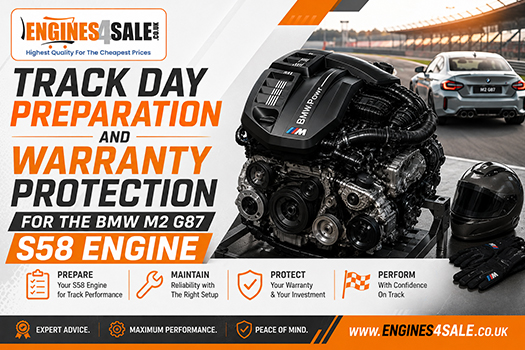
Track Day Preparation and Warranty Protection for the BMW M2 G87 S58 Engine
For owners who regularly take their M2 G87 onto a circuit, protecting the Rebuilt BMW M2 S58 engine warranty is as much about preparation as it is about paperwork. This guide is built around practical, repeatable habits: what to check before a session, how to look after the engine afterward, and how to keep the kind of records that hold up if an oil consumption claim is ever needed.
Treat this as a working checklist rather than background reading — the habits below are designed to be used every single-track day.
Pre-Session Inspection Routine
A thorough check before every track outing reduces the risk of engine damage and builds the evidence trail BMW expects to see if a warranty question arises later.
- Oil level checked via iDrive and confirmed against the dipstick where possible
- Coolant level and condition verified
- Brake fluid condition checked
- Tyre pressures set for track conditions
- Visual inspection for any signs of leaks
- Confirmation that BMW-approved Longlife-04 oil is in use
During the Session
How the car is driven matters almost as much as how it is maintained. Sustained extreme RPM use and repeated launch-control activation are exactly the patterns BMW assessors look for when questioning whether wear came from a defect or from usage.
Session Habits and Their Warranty Impact
| Habit | Effect on Engine | Warranty Impact |
| Gradual warm-up before hard laps | Reduces thermal shock | Supports normal-use argument |
| Avoiding repeated launch control | Lowers drivetrain and engine stress | Reduces misuse concerns |
| Monitoring oil temperature gauges | Flags early overheating risk | Shows proactive care |
| Sustained redline running | Increases piston ring and turbo load | Raises questions during assessment |
Post-Session Cool-Down Protocol
After hard laps, letting the engine idle for roughly 3 to 5 minutes helps dissipate turbocharger heat soak and lowers the risk of oil coking, a common contributor to long-term oil consumption problems. Skipping this step is one of the most common reasons dealers question a claim on a tracked car.
Documentation That Protects Your Warranty
Good documentation is the difference between a smooth warranty claim and a drawn-out dispute. Owners should treat every track day like an entry in a logbook, not an isolated event.
- Oil level readings logged before and after every event
- Photos or screenshots of iDrive oil data with visible dates
- Receipts for spare approved engine oil carried on the day
- Full, unbroken service invoices
- Notes on cool-down routine followed after each session
- Any diagnostic reports from a used BMW engine specialist familiar with the S58
Choosing Oil and Servicing Intervals for Track Use
Track-driven cars benefit from more frequent oil changes than the standard road-use schedule, since higher sustained loads accelerate lubricant breakdown. Only Longlife-04 or LL-01 FE specification oils in viscosities such as 0W-30 or 5W-30 should be used, matched to climate and manufacturer guidance.
If Oil Consumption Develops Despite Good Habits
Even well-maintained cars can develop a genuine internal fault. In that case, the same records built up over months of track use become the strongest evidence for a warranty claim, and if the claim is refused, UK repair costs for the S58 typically fall between £4,200 and £8,500 or more, with a reconditioned BMW engine offering a lower-risk alternative to a full rebuild.
Building a Track-Day Maintenance Calendar
Rather than treating each track day as an isolated event, experienced M2 G87 owners build a recurring maintenance calendar around their season of driving. This turns preparation into a habit rather than a last-minute checklist, and naturally produces the kind of continuous documentation that supports a warranty claim if one is ever needed.
Sample Track-Season Maintenance Calendar
| Timing | Task | Purpose |
| 1 week before each event | Full fluid and tyre inspection | Catch developing issues early |
| Morning of the event | Oil level check via iDrive plus dipstick | Confirm baseline before driving |
| Immediately after the event | Oil level recheck and cool-down idle | Detect same-day consumption, reduce heat soak |
| Every 3-4 track events | Oil and filter change | Offset accelerated lubricant breakdown |
| End of season | Full specialist inspection | Catch cumulative wear before winter storage |
Common Mistakes That Undermine Track-Day Preparation
Even enthusiastic owners sometimes fall into habits that quietly work against them, both mechanically and from a warranty perspective. Recognising these patterns early prevents them from becoming a recurring problem across an entire season.
- Assuming a factory oil level check the week before is still valid on the day of the event
- Driving straight from a cold start into hard laps without a proper warm-up phase
- Topping up with whatever oil is available at the circuit rather than a BMW-approved spec
- Skipping the cool-down idle because of time pressure to leave the circuit
- Failing to note track conditions, ambient temperature, or session length in any log
What to Do If You Notice a Problem Mid-Season
If oil consumption appears to increase during an active track season, the right response is to pause and investigate rather than continue the calendar as planned. Reducing session intensity, rechecking oil levels more frequently, and booking a diagnostic appointment promptly all help limit further wear while the underlying cause is identified.
Continuing to track hard through a developing fault is one of the most common ways an otherwise strong warranty case is weakened, since it can be interpreted as knowingly continuing to stress a failing component.
Adapting the Routine for Different Track Conditions
Not every circuit or climate place the same demand on the S58 engine, and the maintenance routine above should flex accordingly. Hot summer track days, high-altitude circuits, or events involving back-to-back sessions with minimal rest between them all increase thermal load beyond what a single, generic checklist accounts for.
Owners attending events in particularly hot conditions should consider shortening session length, increasing the frequency of oil level checks between runs, and extending the post-session cool-down idle beyond the usual 3 to 5 minutes to give the turbocharger additional time to shed heat before shutdown.
Adjusting the Routine by Condition
| Condition | Recommended Adjustment |
| High ambient temperature (30°C+) | Shorter sessions, longer cool-down idle |
| Back-to-back sessions, minimal rest | Extra oil check between each session |
| High-altitude circuits | Monitor boost and oil temperature gauges closely |
| Cold, damp conditions | Extended warm-up before hard acceleration |
Bringing New Owners Up to Speed
Owners who are new to track driving with the M2 G87, or who have bought the car second-hand without a track history, benefit from spending their first one or two sessions purely on habit-building rather than outright pace. Learning the cool-down routine, getting comfortable with iDrive oil logging, and understanding what a normal versus concerning reading looks like before pushing hard reduces the chance of an avoidable mistake early in ownership.
This early investment in good habits tends to pay off for the entire time the car is owned, since the record-keeping discipline becomes automatic rather than something that has to be relearned under pressure after a problem appears.
Involving a Specialist Before Problems Start
Rather than waiting for a BMW specialist relationship to begin only after a fault appears, many experienced M2 G87 track-day owners build that relationship proactively, scheduling an annual inspection specifically aimed at catching early signs of wear in the piston rings, turbocharger seals, or PCV system before they progress into a measurable consumption problem.
A specialist familiar with a specific car over multiple seasons is also far better placed to spot subtle changes in behaviour than one seeing the vehicle for the first time, which can make an enormous difference to how quickly a genuine fault is caught.
This ongoing relationship also tends to smooth out any future warranty conversation, since a specialist who has documented the car’s condition over several seasons can provide a far more credible independent account than a one-off inspection carried out only after a problem has already been noticed.
A Simple Pre-Event Checklist to Print or Save
- Oil level confirmed via iDrive and dipstick
- Coolant and brake fluid checked
- Tyre pressures set for the circuit
- Approved oil carried as a spare
- Cool-down plan agreed before the first session
Frequently Asked Questions
How long should I let the engine idle after a track session?
Around 3 to 5 minutes is generally recommended to reduce turbocharger heat soak.
What oil specification is required for track use?
Longlife-04 or LL-01 FE approved oil, typically in 0W-30 or 5W-30 depending on climate.
Do more frequent oil changes protect my warranty?
Yes, more frequent changes plus documented checks support a normal-use argument if a claim is ever needed.
What single habit most affects warranty outcomes?
Consistent oil level checks and cool-down periods around every session, backed by written records.
How often should oil be changed during an active track season?
Roughly every 3 to 4 track events is a commonly recommended interval, more frequent than standard road-use servicing.
What should I do if consumption increases mid-season?
Pause hard driving, recheck oil levels more frequently, and book a diagnostic appointment promptly rather than continuing as planned.


Categories
- Aston Martin
- Audi
- Auto News
- Auto Show
- Beijing auto show 2014
- Bentley
- BMW
- Bugatti
- Celebrity
- Chevrolet
- Citroen
- Classic Cars
- Dacia
- Engines
- Ferrari
- Ford
- General
- GM
- Google Car
- Guest Post
- Honda
- Hybrid Cars
- Hydrogen Fuel
- Hyundai
- Infographic
- Isuzu
- Iveco
- Jaguar
- Jeep
- KIA
- Lamborghini
- Land Rover
- Lexus
- Mazda
- McLaren
- Mercedes-Benz
- MINI
- Mitsubishi
- New Technology
- New York International Auto Show 2014
- Nissan
- Peugeot
- Porsche
- RAM
- Range Rover
- Recall
- Renault
- Rolls-Royce
- Saab
- Seat
- Skoda
- Smart
- Subaru
- Supercar
- Suzuki
- Toyota
- Uncategorized
- Vauxhall
- Volkswagen
- Volvo
- Wrong Fuel