Engine Problems, Fixes & Buying Tips
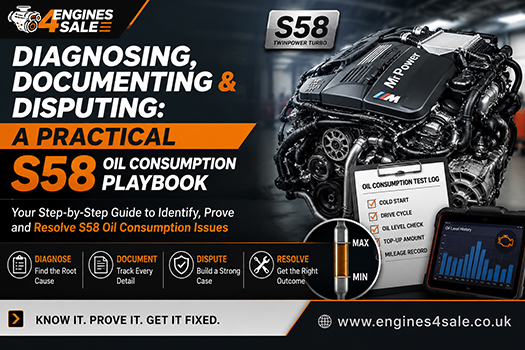
Diagnosing, Documenting and Disputing: A Practical S58 Oil Consumption Playbook
This playbook is written for M2 G87 owners who suspect an oil consumption issue right now and need a clear sequence of steps, rather than general background information. It covers what to do first, how to build a case for a warranty claim, and how to escalate if the dealer says no.
Follow the stages in order — each one builds the evidence needed for the next.
Stage One: Confirm the Problem Exists
Before contacting BMW, establish whether consumption is genuinely abnormal. A single top-up rarely proves anything; what matters is a repeatable pattern over multiple check.
- Log oil level via iDrive at fixed mileage intervals
- Compare readings against BMW’s general tolerance of roughly 0.7 litres per 1,000 miles
- Rule out obvious external leaks before assuming internal consumption
- Note whether the pattern appears mainly in road use or after track sessions
Stage Two: Gather Supporting Evidence
Once a pattern is confirmed, the next step is assembling everything BMW will want to see before authorising work.
Evidence Checklist
| Evidence Type | Source | Purpose |
| Oil level log | iDrive screenshots/photos | Proves consumption pattern |
| Service invoices | Dealer or specialist | Confirms complete maintenance |
| Oil purchase receipts | Retailer or dealer | Confirms approved specification |
| Diagnostic report | BMW or independent specialist | Confirms internal fault |
| Track-day notes | Owner’s own records | Shows correct preparation |
Stage Three: Request an Official Test
With initial evidence in hand, request a formal oil consumption test from BMW, typically run over roughly 1,000 miles, sometimes with the filler cap and dipstick area sealed to prevent uncontrolled top-ups. This controlled result carries far more weight than owner-logged readings alone.
Stage Four: Submit the Warranty Claim
Present the combined evidence — consumption pattern, service history, approved oil use, and diagnostic confirmation such as compression or leak-down testing — as a single, organised package rather than piecemeal information.
- Consumption confirmed above tolerance
- Fault occurring under normal road use
- Approved oil used throughout
- Complete, unbroken service history
- Diagnostic confirmation of an internal issue
- No evidence of neglect or unreported misuse
Stage Five: If the Claim Is Refused
A refusal is not necessarily final. An independent BMW specialist report can challenge the dealer’s conclusion, particularly around disputed track use or ambiguous test results. If the dispute does not succeed, the practical fallback is repair or replacement.
Stage Six: Choosing the Repair Path
Where the claim cannot be recovered, UK repair costs for the S58 engine typically range from £4,200 to £8,500 or more. Owners then generally choose between a full rebuild, a used S58 engine, or a reconditioned BMW engine, weighing upfront cost against long-term reliability and any supplier warranty offered.
Stage Seven: Close Out the Paperwork
Whatever the outcome, keep every document generated during the process. Engine source details, installation invoices, and emissions compliance paperwork protect the car’s tax class for MOT and DVLA purposes and support future resale value.
Stage Eight: Escalating a Disputed Decision
If an initial refusal seems unreasonable given the evidence gathered, most owners have further options before accepting the outcome. BMW’s dealer network typically has an internal escalation path, and a well-organised case file — the same one built in Stage Two — becomes the basis for that escalation.
Requesting a written explanation for the refusal is a useful first move, since it clarifies exactly which piece of evidence or criteria the dealer felt was not met. This often reveals whether the issue is genuinely about the mechanical evidence, or about a documentation gap that can still be closed.
- Request the refusal reason in writing, not just verbally
- Compare the stated reason against the evidence checklist from Stage Two
- Ask whether a second BMW technician or regional assessor can review the case
- Consider a formal complaint through BMW UK’s customer service channel if the dealer-level dispute stalls
Stage Nine: Learning From the Outcome
Whether the claim succeeds, is settled partway, or is ultimately refused, the process itself generates valuable knowledge for the remainder of ownership. Owners who go through a full claim cycle typically emerge with a much clearer sense of exactly what evidence matters, how their specific car behaves, and which maintenance habits genuinely protect them going forward.
This knowledge is worth applying immediately: continue the same oil-logging habit built during the claim process, keep every future service invoice without exception, and treat any subsequent track use with the same documentation discipline that supported this case.
A Quick-Reference Playbook Summary
Playbook Stages at a Glance
| Stage | Core Action |
| 1. Confirm the problem | Log oil readings, rule out leaks |
| 2. Gather evidence | Assemble service, oil, and diagnostic records |
| 3. Request official test | Formal ~1,000-mile monitored test |
| 4. Submit the claim | Present one organised evidence package |
| 5. If refused | Seek independent specialist opinion |
| 6. Choose repair path | Compare rebuild, used, and reconditioned options |
| 7. Close out paperwork | Retain all engine and emissions documentation |
| 8. Escalate if needed | Request written reasons, pursue formal dispute |
| 9. Apply lessons learned | Continue disciplined logging and servicing |
Stage Ten: Keeping a Reusable Template for Next Time
Once the process is complete, it is worth converting the evidence structure used for this claim into a reusable template for the remainder of ownership. A simple recurring log — covering oil level readings, service dates, oil purchases, and any circuit driving — takes only minutes to maintain but removes almost all of the scramble that comes with building a case from scratch after a problem has already appeared.
Owners who maintain this habit consistently often find that, even if a future issue arises, the evidence package can be assembled and submitted within days rather than weeks, since the groundwork has already been laid continuously in the background.
Common Pitfalls That Derail an Otherwise Strong Case
Even well-prepared owners occasionally undermine their own claim through avoidable mistakes made under pressure or time constraints. Being aware of these pitfalls in advance makes them far easier to avoid.
- Submitting evidence piecemeal over several visits instead of as one organised package
- Allowing a service to lapse slightly overdue while a claim is pending
- Continuing hard track use while a suspected fault is still under investigation
- Failing to request anything in writing, leaving the dispute process based only on verbal conversations
- Assuming a specialist’s report alone guarantees approval without engaging BMW’s formal process
Adapting the Playbook for a Second-Hand M2 G87
Owners who bought their M2 G87 used engine, without a full history of the previous owner’s maintenance or track use, should treat Stage One with extra caution. Establishing a fresh, clean baseline of oil level readings over the first few months of ownership is essential, since any consumption pattern inherited from before purchase may not be fully understood yet.
In this situation, a pre-emptive independent inspection shortly after purchase, covering compression, leak-down, and a general visual check, is a worthwhile investment even if no problem is currently suspected, since it establishes a documented starting point that protects the new owner going forward.
It is also sensible to contact the previous owner, where possible, to request any oil logs, service invoices, or track-day records they may still hold. Even partial history from before the change of ownership can strengthen a future claim considerably compared with starting entirely from scratch.
A Final Word on Discipline Over Time
The single biggest predictor of a smooth outcome across every stage of this playbook is not any one document or test, but sustained discipline over months and years of ownership. Owners who treat logging and documentation as a permanent habit, rather than a one-time task tied to a single claim, consistently report faster resolutions and fewer disputes over the life of the car.
This playbook works best as a living reference rather than a one-time read: revisit the stages periodically, adjust the templates as the car’s usage pattern changes, and treat every service or track day as another entry in an ongoing record rather than an isolated event.
Frequently Asked Questions
What is the very first step if I suspect oil consumption?
Start logging oil level readings via iDrive at fixed mileage intervals to confirm a genuine pattern before contacting BMW.
How should I present evidence to BMW?
As one organised package covering consumption data, service history, approved oil receipts, and diagnostic results.
What can I do after a claim is refused?
Seek an independent BMW specialist report to support a dispute, or move directly to comparing repair and replacement options.
Does the repair process affect my car’s tax class?
Not if a like-for-like replacement is installed correctly and all supporting paperwork is retained.
How do I escalate a refusal that seems unfair?
Request the refusal reason in writing and compare it against your evidence file before pursuing a formal dispute through BMW UK.
What should I do differently after going through this process once? Continue the same disciplined oil-logging and record-keeping habits permanently, since they protect against any future claim.


Categories
- Aston Martin
- Audi
- Auto News
- Auto Show
- Beijing auto show 2014
- Bentley
- BMW
- Bugatti
- Celebrity
- Chevrolet
- Citroen
- Classic Cars
- Dacia
- Engines
- Ferrari
- Ford
- General
- GM
- Google Car
- Guest Post
- Honda
- Hybrid Cars
- Hydrogen Fuel
- Hyundai
- Infographic
- Isuzu
- Iveco
- Jaguar
- Jeep
- KIA
- Lamborghini
- Land Rover
- Lexus
- Mazda
- McLaren
- Mercedes-Benz
- MINI
- Mitsubishi
- New Technology
- New York International Auto Show 2014
- Nissan
- Peugeot
- Porsche
- RAM
- Range Rover
- Recall
- Renault
- Rolls-Royce
- Saab
- Seat
- Skoda
- Smart
- Subaru
- Supercar
- Suzuki
- Toyota
- Uncategorized
- Vauxhall
- Volkswagen
- Volvo
- Wrong Fuel