Engine Problems, Fixes & Buying Tips
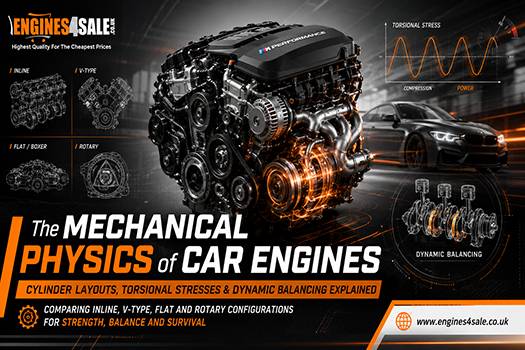
The Mechanical Physics of Car Engines: Cylinder Layouts, Torsional Stresses, and Dynamic Balancing Explained
The Automotive Engineer’s Manual: Comparing Inline, V-Type, Flat, And Rotary Configurations for Strength, Balance, And Survival
Executive Summary
Behind every turn of a wheel lies a complex set of physical forces, thermodynamic laws, and rotational stresses. When an engine is running, its internal parts are subjected to intense friction, high temperatures, and violent shifts in direction. For example, a piston can change direction up to 200 times per second at high engine speeds.
For automotive technicians, rebuilders, and performance enthusiasts, an engine is not just a source of power; it is a finely tuned system of moving parts. Every design choice—whether it is an inline engine, a V-type engine, or a flat (boxer) engine—represents a specific engineering balance between size, power density, manufacturing cost, and natural balance.
This technical guide takes a deep look at the physics of modern car engines. We will analyze the structural stresses that cause engine failures, compare cylinder arrangements, look at primary and secondary balance, and evaluate how to choose a strong, reliable block when looking for a used engine or a high-quality reconditioned engine.
- The Critical Concept: Understanding how different engine designs balance internal forces helps you predict where they are likely to fail under heavy use.
- Sourcing Smart: If you need to replace a damaged block, using a specialized matching platform like www.engines4sale.co.uk helps you locate the exact layout and engine code you need without compatibility issues.
Section 1: The Physics of Engine Balance — Primary vs. Secondary Forces
To understand why certain engines run as smoothly as silk while others vibrate violently, we must look at the math and physics of engine balance. When an engine runs, it produces two main types of vibrating forces: reciprocating forces (from the pistons and connecting rods moving up and down) and rotating forces (from the crankshaft webs spinning around).
These forces are split into primary and secondary vibrations:
Primary Vibrations (First-Order Forces)
Primary forces happen at the same frequency as the engine’s speed (once per crankshaft revolution).
- The Cause: When a piston flies up to Top Dead Center (TDC) and stops, its weight tries to pull the entire engine upward. When it reaches Bottom Dead Center (BDC), it tries to pull the engine downward.
- The Fix: Heavy counterweights are machined directly onto the crankshaft opposite the crankpins to balance out these forces.
Secondary Vibrations (Second-Order Forces)
Secondary forces happen at twice the engine’s speed (twice per crankshaft revolution). These vibrations are much harder to control.
- The Cause: Connecting rods do not just move straight up and down; they also swing side to side. Because of the rod angle, the piston travels faster through the top half of its stroke than the bottom half. This speed difference creates an upward shaking force twice every turn of the crank.
- The Fix: This force cannot be balanced by simple crankshaft counterweights. Engineers must use counter-rotating balancer shafts spinning at twice the engine’s speed to smooth out these vibrations.
Section 2: Cylinder Layouts — Structural Strengths and Weaknesses
How the cylinders are arranged in an engine block affects its strength, how easy it is to cool, its life expectancy, and how difficult it is to work on.
+——————-+——————-+——————-+——————-+——————-+
| Engine Layout | Primary Balance | Secondary Balance | Torsional Rigidity| Common Failures |
+——————-+——————-+——————-+——————-+——————-+
| Inline-Four (I4) | Inherently Perfect| Poor (requires | Very High | Head gasket warp, |
| | | balancer shafts) | | balance shaft wear|
+——————-+——————-+——————-+——————-+——————-+
| Inline-Six (I6) | Inherently Perfect| Inherently Perfect| Low (long crank | Crank flex, rear |
| | | | prone to twisting)| cylinder overheat |
+——————-+——————-+——————-+——————-+——————-+
| V6 (60-Degree) | Good | Moderate | High | Timing chain wear,|
| | | | | oil leaks |
+——————-+——————-+——————-+——————-+——————-+
| Flat-Four (Boxer) | Inherently Perfect| Inherently Perfect| High | Head gasket leak, |
| | | | | oil starvation |
+——————-+——————-+——————-+——————-+——————-+
1. Inline (Straight) Engines: The Compact Workhorses
Cylinders are lined up in a single row. This is the most common layout for four-cylinder commuter engines and BMW’s famous straight-six petrol and diesel engines.
Inline-Four (I4) Dynamics
- The Good: Simple to build, highly rigid, and has only one cylinder head, which means fewer moving parts like camshafts, valves, and timing gears.
- The Bad: It has a natural secondary shaking force. If the engine is larger than 2.0 litres, these vibrations become very noticeable, requiring heavy balancer shafts that rob power and add complexity.
Inline-Six (I6) Dynamics
- The Good: The holy grail of engine design. The front three cylinders move in perfect opposition to the rear three, naturally canceling out all primary and secondary vibrations. It is incredibly smooth without needing balance shafts.
- The Bad: The engine block and crankshaft are physically very long. This makes the crankshaft prone to torsional twisting (flexing) at high RPM, which can cause bearing wear at the ends. Additionally, the cylinder’s furthest from the radiator (Cylinders 5 and 6) run hotter, making them more prone to head gasket failure if the cooling system is neglected.
2. V-Type Engines: High Power in a Small Space
Cylinders are arranged in two angled banks forming a “V” shape connected to a single crankshaft. This layout is popular for V6, V8, and V12 performance cars.
- The Good: By folding the cylinders into a V, the engine is much shorter than an inline design. This allows for a shorter, thicker crankshaft that is incredibly rigid and resistant to flexing, making it excellent for high-horsepower use.
- The Bad: V-engines are wide, heavy, and complex. They have two cylinder heads, two timing chain setups, and double the valvetrain components, which makes them expensive to rebuild.
- The Crucial V-Angle:
- 90-Degree V8: Perfect natural balance for a V8 engine.
- 60-Degree V6: The smoothest angle for a V6.
- 90-Degree V6: Often created by cutting two cylinders off a V8. This angle has uneven firing intervals and requires a complex split-journal crankshaft or balancer shafts to run smoothly.
3. Flat (Boxer) Engines: The Low-Gravity Specialists
Cylinders sit horizontally flat in two opposing rows, punching outward like two boxers. This design is used almost exclusively by Subaru and Porsche.
- The Good: Excellent natural balance. As opposing pistons move outward and inward at the same time, they cancel out each other’s primary and secondary vibrations. Because the engine lies flat, it sits very low in the chassis. This lowers the car’s center of gravity, dramatically improving cornering stability and handling.
- The Bad: Working on a boxer engine can be difficult. Simple jobs like changing spark plugs or valve cover gaskets can require dropping the entire engine because the cylinder heads face the car’s frame rails. Gravity also works against this design: oil can pool on the lower side of the cylinder walls when parked, leading to smoky cold starts and accelerated piston ring wear.

Section 3: The Threat of Torsional Vibration & Crankshaft Failure
Every time a cylinder fires, a massive force strikes the piston, pushing the connecting rod down and forcing the crankshaft to turn. This sudden force does not just turn the crankshaft; it actually bends and twists it.
[Piston Fires]
│ (Sudden Downward Force)
▼
[Connecting Rod]
│
▼
►►►► [CRANKSHAFT TWISTS] ◄◄◄◄ (Torsional Flex)
│
(Absorbed by Harmonic Balancer)
How Torsional Flex Destroys Engines
The crankshaft is made of steel or iron, but under tons of combustion pressure, it acts like a stiff spring. It twists slightly when a cylinder fires, and then springs back. This is called torsional vibration.
- If these vibrations match the natural frequency of the crankshaft, they can build up. This can cause the crankshaft to fatigue, crack, and eventually snap in two.
- To prevent this, engineers install a harmonic balancer (damper) on the front of the crankshaft. This pulley uses a vulcanized rubber ring to absorb and damp these micro-twists before they can damage the crankshaft.
- Rebuilder’s Warning: If you are installing a reconditioned engine, never reuse an old, cracked harmonic balancer. If the rubber in the pulley is worn out, it will fail to damp these vibrations, which can destroy the main bearings of your new engine within a few thousand miles.
Section 4: Used vs. Reconditioned Blocks — An Engineering Comparison
If your engine block has failed, you must decide between buying a used engine from a salvage yard or investing in a precision reconditioned engine. Let’s compare what happens to the physical metal in both scenarios.
+———————————–+———————————–+———————————–+
| Mechanical Component | Used Engine (Salvage Unit) | Reconditioned / Remanufactured |
+———————————–+———————————–+———————————–+
| Cylinder Bore Geometry | Oval / Worn (loss of compression) | Precision honed or re-bored to OS |
+———————————–+———————————–+———————————–+
| Crankshaft Journals | Scored or worn (low oil pressure) | Micro-polished to OEM specs |
+———————————–+———————————–+———————————–+
| Crankshaft Bearings | Worn original shells | Brand-new heavy-duty bearings |
+———————————–+———————————–+———————————–+
| Valve Guides & Seats | Carboned / Leaking | Re-cut and hand-lapped for seal |
+———————————–+———————————–+———————————–+
| Gaskets and Oil Seals | Old, brittle rubber | 100% brand-new seals throughout |
+———————————–+———————————–+———————————–+
The Metal Fatigue Reality of Used Engines
When you purchase a used engine, you are buying metal that has already been subjected to millions of heating and cooling cycles.
- Over time, cylinder bores lose their perfect round shape and wear into an oval. This allows combustion gases to blow past the piston rings (blow-by), resulting in high oil consumption and lost power.
- The main and big-end bearing journals on the crankshaft also wear down. This increases the clearances between parts, causing the engine’s oil pressure to drop when warm.
The Science of Reconditioning
A professionally reconditioned engine is rebuilt to resolve these wear issues:
- Cylinder Re-Boring: The cylinder bores are machined to a slightly larger size to make them perfectly round again. They are then finished with a cross-hatch pattern (honing) to help the new piston rings seal and retain oil for lubrication.
- Crankshaft Grinding: If the crankshaft is worn or scored, it is ground down to a precise undersize. The journals are micro-polished to a mirror finish, and matching oversized bearing shells are installed to restore factory oil clearance.
- Cylinder Head Re-Surfacing: The cylinder head is skimmed using a high-speed milling machine to ensure it is perfectly flat. This prevents head gasket failure after reassembly.
Section 5: The Master Rebuilder’s Assembly Guide
If you are replacing or rebuilding an engine, following these exact engineering steps during installation will ensure it runs reliably for years to know.
1. Checking Bearing Clearances with Plastigauge
Never trust that your bearing clearances are correct without measuring them yourself.
- Clean the crankshaft journals and bearing shells thoroughly.
- Place a small strip of Plastigauge (a special wax wire) across the journal.
- Install the bearing cap and torque the bolts to the exact factory specification. Do not turn the crankshaft while doing this.
- Remove the bearing cap. The wax strip will have flattened. Measure the width of the flattened wax against the provided scale to determine your exact oil clearance down to the thousandth of a millimeter.
- The Target: For most modern passenger cars, oil clearances should be between 0.025mm and 0.050mm. Any wider, and the engine will suffer from low oil pressure; any tighter, and the bearings will overheat and seize.
[Step 1: Place Wax Wire] [Step 2: Torque Cap] [Step 3: Measure Flattened Wax]
┌─────────┐ ┌─────────┐ ┌─────────┐
│ Journal │ │ Cap │ │ Journal │
│ (○) ░ │ │ (○) █ │ │ (○) ▬ │ <– Measure width
└─────────┘ └─────────┘ └─────────┘
2. Proper Bolt Torquing and “Yield-to-Plastic” (Stretch Bolts)
Modern engines use Torque-to-Yield (TTY) bolts for critical areas like the cylinder head, main bearing caps, and connecting rod caps.
- The Science: These bolts are designed to stretch slightly when tightened, acting like a very strong spring to hold parts together under intense cylinder pressure.
- The Golden Rule: TTY bolts are single-use only. Once they have been torquing to their yield point, they lose their elasticity. If you reuse them, they can snap during installation or back out under load, leading to catastrophic engine failure. Always install brand-new bolts and follow the manufacturer’s angle-tightening specifications (e.g., Torque to 30Nm, then turn an additional 90 degrees twice).
3. Cleanliness is Essential
Microscopic dust and metal particles are the worst enemies of a fresh engine.
- Before assembly, clean the block, crankshaft, oil passages, and cylinder head with specialized brake cleaner and compressed air.
- Apply high-quality engine assembly lube (not standard engine oil) to all bearing surfaces, camshaft lobes, and lifters. Assembly lube is thick and sticky, ensuring these parts are lubricated during the critical first few seconds of startup before the oil pump builds up pressure.

Frequently Asked Questions (FAQs)
1. Why do inline engines have better natural balance than V-engines?
Inline-six engines have perfect natural balance because their cylinders operate in symmetrical pairs. Cylinder 1 moves in tandem with Cylinder 6, 2 with 5, and 3 with 4. This layout cancels out all primary and secondary vibrating forces. In contrast, V-engines split their cylinders into two angled banks, which introduces rocking motions that must be balanced with heavy counterweights or specialized balancer shafts.
2. What causes an engine to “throw a rod”?
Throwing a rod occurs when a connecting rod breaks or detaches from the crankshaft. This is usually caused by oil starvation or bearing failure. When a bearing loses lubrication, it generates extreme friction and heat, welding itself to the crankshaft journal. The rod then seizes, bends under the immense force of the piston, and snaps, flying through the side of the aluminum engine block.
3. Can I use a standard used engine in a high-performance track car?
Using a standard used engine for racing or track use is highly risky. Track driving subjects an engine to sustained high RPM, cornering forces that can pull oil away from the pickup tube, and extreme heat. A used engine may already have minor bearing wear or cylinder ovality that will fail quickly under these conditions. For track or performance use, always choose a high-quality reconditioned engine upgraded with performance bearing shells (like King Racing or ACL) and ARP high-tensile hardware.
4. Why is a flat (boxer) engine less prone to vibrations?
Boxer engines feature pistons that move horizontally in opposite directions. When a piston on the left side moves outward, the opposing piston on the right side moves outward at the exact same speed and force. This horizontal movement naturally cancels out primary and secondary shaking forces, making the engine exceptionally smooth without needing heavy balancer shafts.
5. What is the difference between casting and forging for engine parts?
- Casting: Molten metal is poured into a mold. This is a cost-effective way to make complex shapes like engine blocks, but cast parts have microscopic air pockets and are more brittle.
- Forging: Hot metal is stamped into shape under immense pressure. This aligns the grain structure of the metal, making forged pistons, connecting rods, and crankshafts significantly stronger and more resistant to fatigue under high boost or high RPM.
6. How do I get an accurate replacement engine quote?
To ensure you get an accurate quote, you must provide your vehicle’s registration number or VIN. This allows the supplier to check the manufacturer’s database for your exact engine code, emissions standard, and transmission fitment. Sourcing your engine through a verified portal like www.engines4sale.co.uk ensures you get matched with high-quality suppliers that stock the exact configuration you need.


Categories
- Aston Martin
- Audi
- Auto News
- Auto Show
- Beijing auto show 2014
- Bentley
- BMW
- Bugatti
- Celebrity
- Chevrolet
- Citroen
- Classic Cars
- Dacia
- Engines
- Ferrari
- Ford
- General
- GM
- Google Car
- Guest Post
- Honda
- Hybrid Cars
- Hydrogen Fuel
- Hyundai
- Infographic
- Isuzu
- Iveco
- Jaguar
- Jeep
- KIA
- Lamborghini
- Land Rover
- Lexus
- Mazda
- McLaren
- Mercedes-Benz
- MINI
- Mitsubishi
- New Technology
- New York International Auto Show 2014
- Nissan
- Peugeot
- Porsche
- RAM
- Range Rover
- Recall
- Renault
- Rolls-Royce
- Saab
- Seat
- Skoda
- Smart
- Subaru
- Supercar
- Suzuki
- Toyota
- Uncategorized
- Vauxhall
- Volkswagen
- Volvo
- Wrong Fuel