Engine Problems, Fixes & Buying Tips
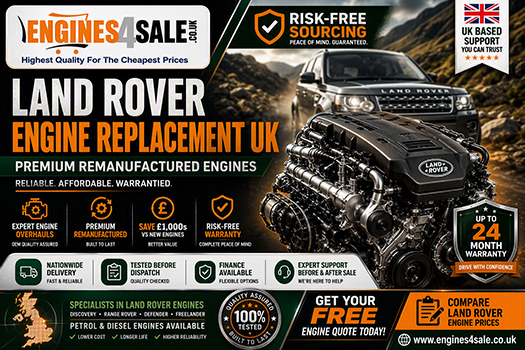
The Land Rover Engine Overhaul Guide: Premium Remanufacturing Solutions, Cost Realities, & Risk-Free Sourcing for UK Owners
Executive Summary
For drivers of a Discovery, Defender, Range Rover, or Freelander facing catastrophic engine failure, purchasing a brand-new factory crate motor is rarely the most practical financial option. Choosing a reconditioned Land Rover engine serves as a highly reliable, cost-effective alternative—frequently reducing your overall expenses by 40% to 60% compared to main dealer rates while offering comparable longevity when built to professional standards.
However, the UK’s engine rebuilding market is highly variable. While elite, marque-specific engineering firms rebuild powerplants to exceed original factory durability, lower-end operators simply clean external parts and label them “fully reconditioned”. Sourcing a dependable replacement requires a clear understanding of precision machining standards, model-specific design upgrades, and written warranty terms.
- The Key Verdict: Investing in a professionally remanufactured motor from a dedicated Land Rover specialist provides the ideal balance of performance, durability, and financial protection. Avoid cheap, unverified used salvage yard engines unless you are prepared to cover immediate repair costs, and never buy without checking the builder’s credentials.
- Essential Caveats: Highly popular powerplants like the TDV6, SDV6, and Ingenium possess inherent design flaws that must be actively corrected during assembly. Simply replacing broken parts with identical standard components is a recipe for a repeat failure. Additionally, remember to factor in regional UK garage labor fees, which typically add £1,200 to £2,500 depending on vehicle complexity.
- Our Service: We operate as a dedicated price comparison platform to match you with vetted UK engine specialists. Final transaction pricing, warranty terms, and shipping logistics are the sole responsibility of the individual suppliers. We always advise securing a professional mechanical diagnostic report before purchasing any replacement unit.
Navigating Your Options: Salvage Yards vs. Rebuild Specialists vs. Dealerships
When faced with a blown motor, you must choose between three distinct replacement strategies. Each path represents a completely different balance of upfront cost, risk profile, and long-term reliability.
+———————————————————————————+
| DECISION ROADMAP |
+———————-+————————–+——————————-+
| Route | Average Upfront Cost | Risk Profile & Longevity |
+———————-+————————–+——————————-+
| Used (Breakers Yard) | Low (£800 – £2,000) | High (Unknown wear & history) |
| Reconditioned | Moderate (£2,500 – £5,500)| Low (Corrected designs) |
| New OEM (Main Dealer)| High (£6,000 – £12,000+) | Minimal (Brand new, expensive)|
+———————-+————————–+——————————-+
1. The Used Engine Route (Salvage Breakers)
Typically costing between £800 and £2,000 depending on the model and mileage, used engines from written-off or dismantled vehicles are the cheapest short-term option. However, they are highly risky: they rarely come with verifiable maintenance history, and internal wear remains completely invisible until installation. Backed by short 30-to-90-day parts-only warranties, a used unit can quickly turn into a massive financial loss if it fails soon after installation.
2. The Reconditioned Specialist Route
A high-quality rebuilt Land Rover engine typically ranges from £2,500 to £5,500 depending on model complexity. This process involves completely stripping the engine to its bare block, testing every structural component, precision machining worn surfaces, and installing upgraded internal parts. When performed correctly, this process addresses original factory weaknesses, improving long-term durability. Most reputable UK suppliers back their work with a solid 12-to-24-month warranty.
3. The New OEM Route (Main Dealer)
Sourced directly through authorized Land Rover dealerships, brand-new replacement engines command premium pricing—frequently ranging from £6,000 to over £12,000. While this guarantees zero wear and a manufacturer warranty, it is financially impractical for older vehicles. On many pre-2015 models, the cost of a new dealer-fitted engine can easily exceed the overall market value of the entire vehicle.
Technical Fault Patterns: Critical Upgrades Your Rebuilder Must Perform
To secure a reliable Discovery reconditioned engine or Range Rover engine replacement, you must choose a builder who understands the specific engineering flaws of these powerplants. Standard rebuilders often overlook these weak points, while specialized rebuilders actively correct them.
1. The TDV6 & SDV6 Diesel (2.7L & 3.0L Variants)
Powering the Discovery 3, Discovery 4, and older Range Rover Sport models, these V6 diesel engines have well-documented mechanical vulnerabilities.
TDV6 / SDV6 COMMON WEAKNESSES & SPECIALIST CURES
+———————————————————–+
| Issue: Crankshaft Fracture –> Solution: Forged Crank |
| Issue: Main Bearing Rotation –> Solution: Keyed Bearings |
| Issue: Timing Chain Stretch –> Solution: Upgraded Kits |
| Issue: Cracked EGR Cooler –> Solution: Upgraded Unit |
+———————————————————–+
- Crankshaft Snapping & Bearing Rotation: The 2.7L TDV6 is prone to structural failure of the crankshaft, particularly around the cylinder number 6 journal. This issue is often caused by spun main bearings that block the oil galleries, resulting in oil starvation. The 3.0L SDV6 has a stronger crankshaft design but can still experience failure if the bearing shells shift out of position.
- Timing Chain Wear: The timing chains can stretch over time due to tensioner wear, which can cause the chain to jump teeth and lead to valve-to-piston contact.
- EGR Cooler Cracking: Internal cracks in the exhaust gas recirculation (EGR) cooler can allow coolant to leak into the combustion chambers, causing hydraulic lock and catastrophic engine failure.
2. The Duratorq 2.2L & 2.4L TDCi
These engines power Land Rover Defender models and older Freelanders. While robust, they require specific attention during a rebuild.
- Wet Oil Pump Drive Belt Failure: On 2.2L engines, the oil pump belt runs inside the oil system. Over time, the rubber belt can degrade, shedding debris that clogs the oil pickup strainer and causes oil starvation.
- Tensioner Wear: The timing chain tensioner can fail, leading to loose chains and top-end damage.
- DPF and Carbon Clogging: Frequent short trips can lead to soot buildup, which clogs the EGR system and diesel particulate filter (DPF), causing excessive heat and cracked pistons.
3. The TDV8 3.6L & 4.4L Twin-Turbo Diesel
These high-torque V8 powerplants found in luxury Range Rover models require expert attention during a rebuild.
- Exhaust Camshaft Cam Lobe Wear: Premature wear of the exhaust lobes leads to restricted cylinder breathing, rough idling, and loss of power.
- Degrading Timing Chain Guides: The OEM plastic timing guides break apart over time, leaving plastic fragments in the oil pan and causing chain slack.
- Oil Cooler Gasket Degradation: Internal failure of the oil cooler assembly allows pressurized engine oil to contaminate the cooling system, turning the coolant expansion tank into a thick, sludge-filled mixture.
4. The 2.0L Ingenium Diesel
Found in modern Discovery Sport, Evoque, and Velar models, this lightweight, modular engine has a history of high-profile timing issues.
- Timing Chain Stretch: Poor design on early-generation models (2015-2018) leads to rapid timing chain wear. The initial symptom is a loud metallic rattling on cold starts.
- Fuel Injector Leakage & Seizure: Faulty high-pressure injectors can stick open, over-fueling individual cylinders and melting holes directly through the aluminum pistons.
Anatomy of a Professional Rebuild: Precision Tolerances & Standards
A professional engine rebuild involves more than simply replacing broken parts. A high-quality used Land Rover engine requires precise machining and the installation of fresh wear components.
PRECISION REBUILD TOLERANCES & STANDARDS
+——————–+————————————+
| Rebuilt Phase | Target Manufacturing Specification |
+——————–+————————————+
| Cylinder Head Deck | Warp tolerance below 0.05mm |
| Milling Depth | Max 0.10mm – 0.20mm skim limit |
| Cylinder Bores | Cross-hatch plateau honed finish |
| Bearing Shells | 100% new heavy-duty lead-bronze |
| Seal Interfaces | Multi-Layer Steel (MLS) gaskets |
+——————–+————————————+
Cylinder Head Machining
- Pressure and Vacuum Testing: Heads must be tested under heat and pressure to ensure there are no microscopic cracks.
- Surface Resurfacing: The head mating surface must be milled flat, keeping strictly within Land Rover’s 0.10mm to 0.20mm limit to maintain correct compression ratios.
- Valve Train Refurbishing: Install new valve guides, recut the valve seats, and replace the valve stem seals to prevent oil leaks.
Cylinder Block Prep
- Precision Honing: Cylinder walls must be checked for ovality and taper, bored over-size if out-of-spec, and plateau-honed to create the perfect cross-hatch pattern for oil retention.
- Align Boring: The crankshaft main bearing saddles must be checked for alignment. If warped by heat, they must be line-bored back to a perfectly straight path.
- Crankshaft Balancing: If the crankshaft is within spec, it must be ground and polished, then matched with high-grade replacement bearings.
Essential Parts That Must Be Replaced
A reputable rebuilder should always install brand-new versions of these components:
- Main and connecting rod bearing shells
- Piston rings (properly gapped)
- Complete timing kits (including chains, belts, tensioners, and guides)
- High-output oil pump and water pump assemblies
- All gaskets, valve stem seals, and crankshaft oil seals
- Torque-to-yield head bolts
Step-by-Step Remanufacturing Process
A thorough remanufacturing process follows a structured path to ensure quality and reliability.
+——————-+ +——————-+ +——————-+
| 1. Disassembly | –> | 2. Crack-Testing | –> | 3. Precision |
| & Chemical Wash| | & Assessment | | Machining |
+——————-+ +——————-+ +——————-+ |
v
+——————-+ +——————-+ +——————-+
| 6. Final QC | <– | 5. Clean-Room | <– | 4. Assembly |
| & Dyno Test | | Testing | | & Component Fit|
+——————-+ +——————-+ +——————-+
Stage 1: Strip Down and Chemical Cleaning
The engine is completely stripped down to bare components. Every bolt and clip is sorted, and the block, head, and crank are run through an industrial hot wash and chemical tank to strip away all carbon deposits, oil sludge, and paint.
Stage 2: Structural Integrity Testing
The block and head are tested using Magnaflux (magnetic particle inspection) or dye penetrants to identify any microscopic hairline cracks that could cause structural failure under load.
Stage 3: Precision Machining
Bores are machined, deck surfaces are skimmed, and the crankshaft is polished. New valve guides are pressed in, and the valve seats are recut to restore factory sealing performance.
Stage 4: Dust-Free Assembly
In a clean-room environment, assembly begins using calibrated digital torque wrenches. Piston rings are carefully gapped, and bearing clearances are measured using Plastigage to confirm they match original engineering specifications.
Stage 5: Final Performance Validation
Before leaving the clean room, the engine undergoes a compression test and a cylinder leak-down test to verify ring and valve seating. Some premium builders also place the engine on a running dyno test bench to monitor oil pressure and check for cooling system leaks under load.
UK Market Pricing Guide (2025/2026 Forecast)
Sourcing a rebuilt Land Rover engine requires realistic budgeting. The table below outlines typical pricing across the UK for rebuilt long-block assemblies (including blocks, heads, and internal components).
+———————————————————————————–+
| ENGINE PRICING BY MODEL |
+————————————+———————+————————+
| Engine Model | Base Rebuild Cost | Upgraded Build Cost |
+————————————+———————+————————+
| 2.7L TDV6 (Discovery 3, Sport) | £2,800 – £3,500 | £3,500 – £4,500 (Steel)|
| 3.0L SDV6 (Discovery 4, Range Rover)| £3,200 – £4,000 | £4,000 – £5,200 (Steel)|
| 2.2L Duratorq (Defender, Freelander)| £2,500 – £3,200 | £3,000 – £3,800 (Gear) |
| 2.4L Duratorq (Defender) | £2,400 – £3,000 | £3,000 – £3,800 |
| 3.6L / 4.4L TDV8 (Range Rover) | £4,500 – £6,500 | Varies on turbo inclusion|
| 5.0L Supercharged V8 (Petrol) | £5,500 – £8,500 | Varies on sleeve wear |
| 2.0L Ingenium Diesel (Evoque, Sport)| £4,000 – £6,000 | Includes updated chains|
+————————————+———————+————————+
What’s Included vs. Potential Extra Expenses
- Standard Long-Block Package: Includes the main engine block, cylinder head assembly, complete internal rotating components (crank, rods, pistons), oil pump, water pump, and a complete timing kit.
- External Extras: You should budget extra for accessories like turbochargers (£400–£1,200), brand-new fuel injectors (£800–£1,800 per set), and replacement dual-mass flywheels/clutches (£600–£1,200).
- Average UK Specialist Installation Rates:
- Land Rover Defender: £1,200 – £1,800 (spacious engine bay, simpler electronics).
- Discovery 3 / 4 / 5: £1,500 – £2,200 (complex electronics, body-off removal is often required).
- Range Rover / Range Rover Sport: £1,800 – £2,800 (highly complex plumbing and packaging).
Spotting the Red Flags: How to Screen UK Engine Builders
Avoid choosing a supplier based on price alone. Use this screening guide to differentiate reputable rebuilders from low-quality operators.
+———————————————————————————+
| SUPPLIER RED & GREEN FLAGS |
+—————————————-+—————————————-+
| Red Flags (Avoid) | Green Flags (Trust) |
+—————————————-+—————————————-+
| • Prices far below the market average | • Detailed, itemized quotes |
| • No physical business address | • Specialized Land Rover expertise |
| • Demands full payment in cash | • Comprehensive parts & labor warranty |
| • Short or vague warranty periods | • Positive independent reviews |
+—————————————-+—————————————-+
Critical Questions to Ask Every Supplier
- “Do you install upgraded crankshafts in your TDV6/SDV6 engines to prevent snapping, and how do you secure the main bearings?”
- “Can you provide the actual oil pressure readings, compression numbers, and leak-down test sheets for this specific block?”
- “Is the warranty a parts-only policy, or does it cover the labor costs for removal and replacement if a warranty issue occurs?”
- “Can I pay using a credit card to secure Section 75 consumer protection?”
Protecting Your Investment: Essential Warranty Rules
A rebuilt engine is a significant investment. Protecting that investment requires understanding warranty conditions and following proper installation procedures.
Understanding Warranty Exclusions
Most standard warranties cover the core mechanical parts but exclude external components. If an old, unserviced turbocharger fails and sends metal debris into your new engine, the resulting damage will not be covered under warranty. Similarly, overheating caused by a clogged radiator or a split coolant hose is typically excluded.
Mandatory Installation Steps
To keep your warranty valid, your installer must follow these steps:
- Replace the Oil Cooler: TDV6 and SDV6 failures often leave bearing debris inside the oil cooler. This debris cannot be flushed out reliably, so installing a brand-new oil cooler is mandatory to prevent contaminating the new engine.
- Flush the Radiator and Intercooler: Clear out all sludge and metal filings from the cooling and intake systems.
- Use Specified Oils: Only use high-quality oils that meet Land Rover’s exact specifications.
- Complete the Break-in Service: Change the oil and filter after the first 500 to 1,000 miles to remove any initial break-in wear particles.
Professional Installation vs. DIY Fitting
Deciding whether to fit the engine yourself or hire a professional is a balance of cost, skill, and warranty protection.
INSTALLATION STRATEGY: PRO VS. DIY
+—————————————————–+
| Professional Fitting (Recommended) |
| – Full warranty validation |
| – Specialized tooling (hoists, diagnostic scanners) |
| – Specialized expertise (body-off chassis separation)|
+—————————————————–+
| DIY Fitting (Expert Mechanics Only) |
| – Saves £1,200 to £2,500 in labor |
| – Requires heavy-duty 2-tonne hoists |
| – Risks voiding supplier parts-and-labor warranty |
+—————————————————–+
- Professional Fitting: Hiring a specialist garage is highly recommended. For complex models like the Discovery 4, separating the body from the chassis is often the most efficient way to access the engine. A professional shop has the lifting equipment and diagnostic tools to complete the job safely and keep your warranty intact.
- DIY Fitting: This should only be attempted by highly experienced mechanics with access to a heavy-duty workshop hoist, a transmission jack, and Land Rover-compatible diagnostic software. While it saves on labor, any mistake during installation can void the engine supplier’s warranty.
Frequently Asked Questions
What is the realistic price for a reconditioned Land Rover engine in the UK?
A quality reconditioned engine block typically costs between £2,500 and £5,500 depending on the specific engine model. When you factor in professional installation, fresh fluids, a new oil cooler, and diagnostic programming, the total drive-away cost usually ranges from £4,500 to £8,500.
How is a “reconditioned” engine different from a “used” one?
A used engine is simply removed from a donor vehicle and sold “as-is” with its existing wear and unknown history. A reconditioned engine is completely disassembled, thoroughly cleaned, inspected, machined, and rebuilt with brand-new wear parts (such as bearings, rings, seals, and timing components) to restore factory-fresh performance.
How long should a reconditioned engine last?
With regular, high-quality maintenance, a properly reconditioned engine should easily last 100,000 to 150,000 miles. To ensure longevity, always change the engine oil every 8,000 to 10,000 miles, rather than following Land Rover’s longer factory-recommended intervals.
Can I install the engine myself without voiding the warranty?
Many premier engine suppliers require the engine to be installed by a registered, VAT-compliant garage to keep the warranty valid. Always read the supplier’s warranty terms carefully before starting any DIY installation.
Ready to Find a Trusted Engine Specialist?
Don’t gamble with unverified rebuilders. Use our quote-comparison platform to connect with vetted UK Land Rover engine specialists who understand these complex powerplants and offer comprehensive warranties.


Categories
- Aston Martin
- Audi
- Auto News
- Auto Show
- Beijing auto show 2014
- Bentley
- BMW
- Bugatti
- Celebrity
- Chevrolet
- Citroen
- Classic Cars
- Dacia
- Engines
- Ferrari
- Ford
- General
- GM
- Google Car
- Guest Post
- Honda
- Hybrid Cars
- Hydrogen Fuel
- Hyundai
- Infographic
- Isuzu
- Iveco
- Jaguar
- Jeep
- KIA
- Lamborghini
- Land Rover
- Lexus
- Mazda
- McLaren
- Mercedes-Benz
- MINI
- Mitsubishi
- New Technology
- New York International Auto Show 2014
- Nissan
- Peugeot
- Porsche
- RAM
- Range Rover
- Recall
- Renault
- Rolls-Royce
- Saab
- Seat
- Skoda
- Smart
- Subaru
- Supercar
- Suzuki
- Toyota
- Uncategorized
- Vauxhall
- Volkswagen
- Volvo
- Wrong Fuel