Engine Problems, Fixes & Buying Tips
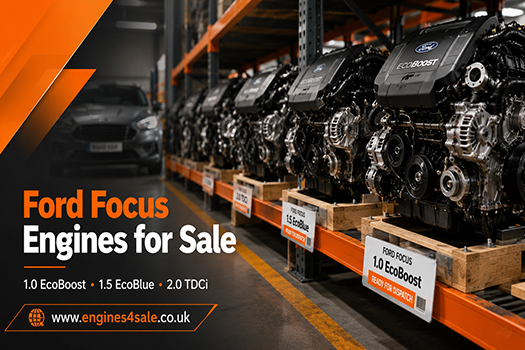
Ford Focus Engines for Sale: Pick the Right One First Time — 1.0 EcoBoost, 1.5 EcoBlue & 2.0 TDCi
Ford Focus Engines for Sale: Compare 1.0 EcoBoost, 1.5 EcoBlue & 2.0 TDCi Before You Buy
Searching for a used Ford Focus engine for sale means navigating dozens of listings, engine codes, and mileage claims — often without knowing which variants are worth your money and which are a gamble you can’t afford. At Engines 4 Sale, we list hundreds of tested Ford Focus engines from verified UK breakers and reconditioners, but the most important decision happens before you click ‘buy.’ This guide walks you through the three Focus engines you’ll see most often in our listings and explains which one fits your car, your mileage, and your budget.
The Ford Focus has used three main engine families across recent generations: the 1.0-litre EcoBoost petrol, the 2.0-litre Duratorq TDCi diesel, and the 1.5-litre EcoBlue diesel introduced in 2018. Each has its own set of strengths, known failure points, and price brackets in the used engine market. Knowing these details before you browse our stock means you can filter listings confidently and avoid purchasing an engine that brings someone else’s maintenance neglect to your driveway.
Quick Comparison: What You Will Find in Our Ford Focus Engine Listings
- 1.0 EcoBoost Petrol: Listed from £700-£1,400. Check the wet timing belt replacement history before buying.
- 2.0 TDCi Diesel: Listed from £900-£1,800. High-mileage units are common — focus on service history, not just mileage.
- 1.5 EcoBlue Diesel: Listed from £1,200-£2,200. Newer engine, fewer donor vehicles, higher entry price.
- Average fitted cost: Add £1,000-£1,800 for labour, depending on your local garage rate.
- MOT compliance: Diesel Focus engines must include a functioning DPF — any unit sold without one will cause an MOT failure.
1.0 EcoBoost Engines for Sale: What to Ask the Seller Before You Buy
The 1.0-litre EcoBoost is the most frequently listed Focus engine on our platform, and for good reason — it powered the majority of petrol Focus models from 2012 onward. These three-cylinder turbo units are compact, efficient, and widely available used. However, the wet timing belt design means a poorly maintained EcoBoost can fail catastrophically without warning, which is why you should only consider listings that can demonstrate a belt replacement within the manufacturer’s recommended interval.
According to DVSA records, pre-2018 EcoBoost engines suffered from belt material degrading in the oil, blocking the oil pump pickup and causing complete engine seizure. Ford revised the belt specification and offered extended warranty on affected VINs, but a used engine from this era that hasn’t had its belt replaced is a significant risk regardless of the listed mileage.

Three Questions to Ask Every EcoBoost Engine Seller
First: has the wet timing belt been replaced, and can you provide documentary proof? Honestly? a belt replacement costs £1,200-£1,800 at an independent garage, so a unit sold for £800 that needs a £1,500 belt job isn’t the bargain it appears to be. Second: can you provide the engine’s compression test readings across all three cylinders? Healthy values should be within 10% of each other. Third: is the oil pump included and has it been inspected for debris? A belt that has begun to degrade leaves rubber particles in the pump — fitting a used engine with a partially blocked pump will destroy it within the first few hundred miles of service.
Other EcoBoost Issues: Coolant Loss and Overheating
The plastic cooling system components on the EcoBoost — particularly the degas hose and water pump housing — become brittle with age and heat cycling. A cracked hose leaks coolant slowly and can be missed until the engine overheats, warping the cylinder head. When browsing listings, ask the seller to confirm the engine hasn’t been overheated and request photographs of the cooling system connections. If you see white, crusty residue around the coolant ports, the engine has likely suffered a coolant leak at some point in its life.
2.0 TDCi Engines for Sale: What Makes a Good One Worth the Money
The 2.0-litre Duratorq TDCi diesel — often identified by the DW10 engine family code — is the workhorse of the Focus diesel range. A cast-iron block and timing chain (not belt) give it the kind of mechanical longevity that the EcoBoost can’t match, with many units still running strongly past 200,000 miles. The trade-off is that the emissions hardware attached to this engine — DPF, EGR, injector seals — has a finite service life that must be factored into the cost of ownership and the price you are willing to pay for a used unit.
Checking DPF, EGR, and Injector Condition Before Purchase
A TDCi engine removed from a car that spent its life doing short urban journeys will have a DPF approaching full saturation and an EGR valve choked with carbon. These items aren’t internal engine components — you’ll be transferring them from your old engine or sourcing them separately — but a used engine that has spent its life in stop-start traffic will have accelerated carbon build-up throughout the intake and exhaust systems. Ask the seller for the donor vehicle’s MOT history (available free through the DVLA website if you have the registration number) and look for a pattern of consistent mileage suggesting motorway use.
Also check the injector area for signs of black death — hard, tar-like carbon deposits around the base of each injector that indicate leaking copper seals. An engine with significant black death may need specialist injector extraction, adding £300-£600 to the installation cost.
Dual Mass Flywheel: Is It Included?
Most used TDCi engines are sold without the dual mass flywheel, which is considered a consumable item. A DMF typically lasts 100,000-120,000 miles before the internal damping mechanism wears out, causing a rattling noise when the engine is switched off and juddering when pulling away. Budget £600-£900 for a replacement clutch and DMF kit if the donor engine’s mileage suggests the original flywheel is due for renewal.
1.5 EcoBlue Engines for Sale: Newer Tech, Higher Prices, Different Checks
The 1.5-litre EcoBlue replaced the 1.6 TDCi in 2018 and represents the most modern diesel option in the Focus range. It features an integrated exhaust manifold, SCR AdBlue injection, and a chain-driven camshaft. Fewer of these engines have reached the used market simply because the donor vehicles are newer, which keeps prices higher — typically £1,200-£2,200 for a tested used unit. The premium buys you lower average mileage and more recent manufacturing, but also introduces complexity that earlier Focus engines didn’t have.
AdBlue and Camshaft: The Two EcoBlue-Specific Checks
The AdBlue injection system is prone to crystallisation — a white, gritty deposit that blocks the injector nozzle and, if severe, damages the AdBlue pump. When buying a used EcoBlue engine, confirm that the AdBlue injector and pump are included and haven’t been removed or damaged during engine extraction. Budget £350-£800 for AdBlue system repairs if the condition can’t be verified.
Early 2018-2019 EcoBlue engines also experienced camshaft wear caused by insufficient lubrication to the top end during cold starts. Ford released an ECU update to increase oil pressure at low RPM, but engines that ran for significant mileage before the update will have measurable lobe wear. Request the donor vehicle’s service history showing that Ford updates were applied, or factor £1,000-£1,500 for a camshaft replacement into the total cost.

What You Actually Pay: From Listing Price to Running Engine
The price you see on an Engines 4 Sale listing is the starting point. A used EcoBoost listed at £900 may need a £1,500 timing belt replacement before installation. A TDCi listed at £1,200 may need £600 of DMF and clutch work. And labour to fit any of these engine’s averages 12-18 hours at £75-£120 per hour, adding £900-£2,160 to the bill. The smartest buyers calculate the all-in, fitted-and-running price before committing — not just the engine purchase price.
Used vs Reconditioned: What Our Listings Offer
Used engines on our platform are tested and come with a minimum 3-month warranty, but the donor vehicle’s history stays the biggest variable. Reconditioned engines — stripped, cleaned, and rebuilt with new bearing shells, piston rings, gaskets, and timing components — cost £800-£1,200 more but come with 6–12-month warranties and the certainty that all wear items are brand new. If the car is a long-term keeper, the reconditioned route provides better value over two or more years of ownership.
Which Ford Focus Engine Listing Should You Click First?
If your Focus covers 12,000+ miles annually, mostly on motorways, filter our listings for the 2.0 TDCi — prioritise units with documented service history and check that the injector area is clean. If your driving is local and low-mileage, look at post-2019 1.0 EcoBoost listings with belt replacement receipts; avoid anything pre-2018 without proof the belt has been done. The 1.5 EcoBlue is the priciest option and makes sense only if you are keeping the car long enough to justify the AdBlue complexity. Whatever you choose, match the engine code on the listing to the code on your V5C — Ford produced multiple variants of each engine, and the wrong code means it won’t fit. Browse all Ford Focus engines for sale on Engines 4 Sale, filter by price, code, and mileage, and find the right unit at the right price.
The engines on our platform come from breakers and reconditioners across the UK, and every listing shows the engine code, mileage, and any documented service work. Before you click through to a seller, double-check the code against your V5C — Ford used multiple variants of each engine series, and we would rather you check now than discover a mismatch after the engine arrives on a pallet.
We list engines across the full price spectrum because transparency matters. Some buyers have the workshop facilities and time to do a belt replacement themselves, and for them, a cheaper unit makes sense. Most buyers, but want an engine that can be fitted and driven away — and for those buyers, paying more up front for a verified, serviced unit’s nearly always the cheaper route over two years.
When you browse Focus engine listings on Engines 4 Sale, you won’tice significant price variation even between engines that look identical in photographs. A 1.0 EcoBoost at £750 and one at £1,200 might share the same engine code and similar mileage, but the cheaper unit probably has no belt replacement history and an unverified oil pump condition. The difference in final, fitted-and-running cost between those two engines can be £1,000 or more — entirely because of maintenance deferred by the previous owner.
Frequently Asked Questions
How long will a used 1.0 EcoBoost engine last after I buy it?
A well-maintained EcoBoost with a replacement wet belt can reach 150,000 miles. The key is documented oil changes every 10,000 miles with Ford-specification oil — request this evidence from the seller before purchasing.
How do I know a 2.0 TDCi listing is a good engine and not a problem unit?
Check the donor vehicle’s MOT history for consistent mileage, request photos showing a clean injector area (no black carbon deposits), and confirm the mileage matches what the seller claims. A compression test report adds further confidence.
Are 1.5 EcoBlue engines worth the higher listing price?
They’re newer and generally lower-mileage, but the AdBlue system introduces complexity and potential repair costs. Worth the premium only if you can verify the donor vehicle had all Ford ECU updates applied.
Will a diesel Focus engine I buy pass the MOT after fitting?
Only if the DPF is present and functioning. Any diesel engine sold without its original DPF will cause an automatic MOT major failure. Confirm DPF inclusion before completing your purchase.
What does delivery cost on a Ford Focus engine from your platform?
Delivery costs depend on your postcode and the supplier’s location. Engines 4 Sale connects you with UK-wide suppliers, each offering their own delivery terms. Contact the seller directly through the listing for a delivery quote.
Which engines use a timing chain and which use a belt?
The 1.0 EcoBoost uses a wet timing belt (submerged in oil). The 2.0 TDCi and 1.5 EcoBlue both use timing chains, which are generally maintenance-free for the life of the engine when oil is changed regularly.
Can I return a used engine if it does not fit or has problems?
Price filtering is the most useful feature on Engines 4 Sale for Focus buyers, and here is why: the price difference between a basic used engine and a reconditioned unit tells you exactly how much value the reconditioning process adds. If a used 2.0 TDCi is listed at £1,200 and a reconditioned one at £2,100, the £900 difference buys you new bearing shells, new piston rings, new gaskets and seals throughout, and a warranty that’s typically twice as long. For an engine you plan to keep for several years, that £900 is often the best money you’ll spend — because it eliminates the unknown history that’s the biggest variable in any used engine purchase.
Return policies vary by seller. All engines on Engines 4 Sale come with a minimum warranty period, but always read the individual listing terms before purchasing. Check that the engine code matches your V5C to avoid fitment issues. Browse all Ford Focus engines for sale on Engines 4 Sale — filter by price, engine code, and mileage. Find the right unit for your car from verified UK suppliers, with transparent pricing and no hidden fees.


Categories
- Aston Martin
- Audi
- Auto News
- Auto Show
- Beijing auto show 2014
- Bentley
- BMW
- Bugatti
- Celebrity
- Chevrolet
- Citroen
- Classic Cars
- Dacia
- Engines
- Ferrari
- Ford
- General
- GM
- Google Car
- Guest Post
- Honda
- Hybrid Cars
- Hydrogen Fuel
- Hyundai
- Infographic
- Isuzu
- Iveco
- Jaguar
- Jeep
- KIA
- Lamborghini
- Land Rover
- Lexus
- Mazda
- McLaren
- Mercedes-Benz
- MINI
- Mitsubishi
- New Technology
- New York International Auto Show 2014
- Nissan
- Peugeot
- Porsche
- RAM
- Range Rover
- Recall
- Renault
- Rolls-Royce
- Saab
- Seat
- Skoda
- Smart
- Subaru
- Supercar
- Suzuki
- Toyota
- Uncategorized
- Vauxhall
- Volkswagen
- Volvo
- Wrong Fuel