Engine Problems, Fixes & Buying Tips
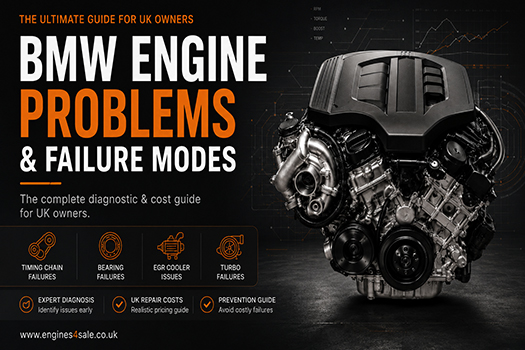
BMW Engine Problems & Failure Modes: The Ultimate Diagnostic & Cost Guide for UK Owners
The Complete BMW Engine Reliability Report: In-Depth Analysis of Timing Chain, Bearing, Egr and Turbo Failures Across Petrol & Diesel Models
Executive Summary
BMW produces some of the most dynamically thrilling, technologically advanced, and high-performing engines in the automotive world. From the buttery-smooth inline-six petrol engines to the highly efficient four-cylinder common-rail diesels, “Bayerische Motoren Werke” literally translates to Bavarian Motor Works—putting engines at the very core of the brand’s identity.
However, behind the high-tech marketing and class-leading performance figures lies a complex reality. Over the last two decades, several major reconditioned BMW engine families have become notorious in the UK automotive aftermarket for specific, highly expensive mechanical and electrical design flaws. Whether it is the catastrophic timing chain failures of the 2.0-litre diesels, the devastating spun rod bearings of the high-performance S-series and N57 engines, or the highly dangerous EGR cooler fires that triggered massive UK safety recalls, owning a modern BMW requires a deep understanding of its engineering vulnerabilities.
If you are currently diagnosing an issue on your vehicle, looking to buy a used BMW, or sourcing a replacement engine in the UK, this definitive guide provides a highly detailed, engine-by-engine blueprint of common failure modes, diagnostic symptoms, prevention strategies, and realistic UK repair costs.
- Key Verdict: A modern BMW engine can easily cross the 150,000-mile mark, but only if you ignore the factory-recommended long-life service intervals and proactively replace known weak wear items (like plastic coolant pipes and timing tensioners) before they fail.
- Critical Caveats: If you are buying any used BMW engine with over 80,000 miles on the clock, you must verify the health of the timing gear and oil delivery systems. Neglecting these areas is the number one cause of sudden, catastrophic engine write-offs in the UK.
Section 1: The Infamous Timing Chain Epidemic (Diesel & Petrol)
Timing chain issues are arguably the most widespread mechanical failures associated with modern BMWs. While a timing chain is theoretically designed to last the entire lifetime of the vehicle, multiple design flaws have turned this component into a high-risk wear item.
1. The 2.0-litre N47 & N47D20A Diesel (2007 – 2015)
- The Problem: As discussed in previous manuals, the early N47 family features an integrated crankshaft sprocket with overly sharp teeth, weak hydraulic tensioners, and brittle plastic guide rails. The entire assembly is mounted at the rear of the block.
- The Catastrophe: The chain stretches, cracks the plastic guides, jumps teeth on the sprockets, or snaps. Because it is an interference engine, the pistons strike the valves instantly, shattering the cylinder head.
- Acoustic Symptoms: A dry, rhythmic “shuff-shuff” or “sweeping” noise from the rear of the engine bay that rises and falls with RPM.
- UK Repair Costs:
- Preventative replacement: £1,200 – £1,800 (requires engine or gearbox removal).
- Post-failure rebuild: £3,500 – £5,000+.
2. The 2.0-litre N20 Twin-Power Petrol (2011 – 2017)
The N20 engine (found in the 320i/328i F30 and 520i/528i F10) was designed to replace the naturally aspirated six-cylinder engines. However, it quickly developed a reputation for timing chain failure similar to the N47.
- The Problem: The plastic timing chain guide rails are highly sensitive to thermal degradation. Over time, heat causes the plastic guides to turn brittle, crack, and break apart. Additionally, the oil pump drive chain module is prone to excessive wear.
- The Catastrophe: The broken plastic shards sink into the oil pan and completely clog the oil pump pickup screen. This starves the engine of oil, leading to sudden crankshaft bearing seizure.
- Acoustic Symptoms: A high-pitched, distinctive whining noise from the front of the engine that sounds similar to a supercharger or a worn power steering pump, which becomes louder as engine RPM increases.
- UK Repair Costs:
- Upgraded chain & guide installation: £900 – £1,400.
- Engine replacement after oil starvation: £4,000 – £6,000.
Section 2: Crankshaft Bearing Failures & Oil Starvation
Crankshaft main and connecting rod bearings require a continuous, highly pressurized film of oil to prevent metal-on-metal contact. Multiple rebuilt BMW engines suffer from issues that disrupt this oil film, leading to catastrophic bottom-end failure (often called rod knock).
1. The N57 3.0-litre Straight-Six Diesel (2008 – 2019)
- The Problem: The N57 utilizes eco-friendly, lead-free bearing shells. Under BMW’s recommended 15,000+ mile oil change intervals, the engine oil suffers from fuel dilution (especially on cars driven mostly on short city trips where DPF regeneration is frequently interrupted). The diluted, thinned-out oil cannot protect the bearings under heavy load.
- The Catastrophe: The bearing shells overheat, deform, spin out of their seats (spun bearing), and weld themselves to the crankshaft journal, completely locking the engine or throwing a rod through the side of the aluminum block.
- Diagnostic Symptoms:
- A deep, heavy, rhythmic metallic knocking sound from the lower section of the engine block, which becomes highly pronounced under light acceleration around 1,500 – 2,000 RPM when the engine is warm.
- Fine, copper- or gold-colored metallic glitter inside the engine oil filter housing.
- UK Repair Costs:
- Full bottom-end rebuild: £4,500 – £7,000+.
2. The S65 (V8) & S85 (V10) M-Power Engines (2005 – 2013)
Found in the legendary E92 M3 and E60 M5, these high-revving naturally aspirated masterpieces are performance royalty, but they have a fatal engineering flaw.
- The Problem: BMW designed these engines with incredibly tight rod bearing-to-journal clearances (often under 0.025mm). This clearance is too narrow for standard 10W-60 oil to flow effectively when the engine is cold.
- The Catastrophe: Cold-start friction rapidly wears down the bearing material. If the bearings are not replaced proactively, they will spin, destroying the incredibly expensive crankshaft and cylinder block.
- Prevention: Proactive replacement of the factory bearing shells with aftermarket high-clearance bearings (such as BE Bearings) combined with ARP bolts is considered mandatory maintenance every 50,000 to 60,000 miles.
- UK Repair Costs:
- Preventative bearing replacement: £1,500 – £2,200.
- Engine replacement post-failure: £10,000 – £15,000+.
Section 3: EGR Cooler Failures & Engine Bay Fires (Diesel)
Modern BMW diesel engines rely heavily on Exhaust Gas Recirculation (EGR) systems to reduce nitrogen oxide (NOx) emissions. This system has been the subject of massive safety recalls in the UK and Europe.
The Recall: N47, N57, B47, and B57 Engines
- The Problem: The EGR cooler uses engine coolant to lower the temperature of hot exhaust gases before they are redirected back into the intake manifold. Over time, the internal cooling pipes of the EGR cooler can develop microscopic stress cracks due to constant thermal expansion.
- The Catastrophe: Coolant leaks inside the hot EGR housing and mixes with the highly concentrated carbon soot deposits. This mixture creates a highly flammable, sticky chemical compound. The intense heat of the exhaust gases can ignite this mixture, melting the plastic intake manifold and, in extreme cases, causing a full-blown engine bay fire.
- Diagnostic Symptoms:
- A slow, mysterious loss of coolant with no visible external leaks or pools under the car.
- A strong, sweet smell of burnt coolant inside the cabin when the heating is on.
- Frequent active regeneration of the DPF and sudden “Drivetrain Malfunction” warnings on the iDrive.
- The UK Status: BMW has run extensive safety recall campaigns in the UK to replace affected EGR coolers and intake manifolds free of charge. If you buy a used BMW diesel, contact a local dealer immediately to verify if there are any outstanding safety recalls on your VIN.
Section 4: High-Pressure Fuel Pump (HPFP) Failures (The CP4 Shrapnel Issue)
Common-rail diesel engines run at massive fuel pressures to ensure complete combustion. Both the N47 and N57 engines rely on the Bosch CP4 high-pressure fuel pump.
- The Design Defect: The CP4 pump uses a single piston operated by a roller cam. It relies entirely on the lubricity of the diesel fuel passing through it to keep its internal parts running smoothly.
- The Failure Process: In the UK and Europe, diesel fuel is highly refined to reduce sulfur, which lowers its natural lubricity. If you accidentally mis fuel the car (introducing even a tiny amount of petrol) or run the fuel tank extremely low, the CP4 pump loses lubrication. The internal roller turns 90 degrees out of alignment and begins grinding directly against the drive shaft.
- The Shrapnel Storm: This grinding action shaves off thousands of microscopic steel shards. Because there is no filter between the high-pressure pump and the fuel injectors, these steel shavings are pumped directly into the common-rail, instantly clogging and ruining all four or six expensive fuel injectors, the rail sensors, and returning contaminated fuel back into the fuel tank.
- Diagnostic Symptoms:
- The engine cuts out suddenly while driving and refuses to restart.
- Removing the fuel metering valve (located on top of the HPFP) reveals a shiny, silver metallic powder coating the valve screen.
- UK Repair Costs: Because the entire fuel system is contaminated, you cannot simply replace the pump. You must replace the HPFP, all injectors, the fuel rail, the fuel lines, and drop and chemically steam-clean the entire fuel tank.
- Total system replacement cost: £3,000 – £5,000.
Section 5: Petrol Engine Specific Issues (Valvetrain, Turbochargers & Injectors)
While BMW’s petrol engines do not suffer from diesel soot buildup, they possess their own unique, highly complex engineering issues.
1. The N54 3.0-litre Twin-Turbo Petrol (2006 – 2013)
Widely regarded as the modern-day “2JZ” due to its incredible tuning potential, this inline-six engine (found in the E90 335i and E82 135i) is fantastic when running well, but is notoriously high-maintenance.
- Wastegate Rattle: The internal wastegate flappers inside the twin turbochargers wear out at their pivot points, causing them to lose fit. This leads to boost leaks, a loss of power, and a loud, metallic rattling noise under deceleration.
- UK Repair Cost: £1,200 – £2,000 (turbos must be removed to rebuild or replace the wastegates).
- Index 12 Injector Failure: The early piezo injectors on the N54 are prone to leaking internally, causing cylinder wash-out, rough idling, and engine misfires. BMW revised these injectors multiple times, with the final “Index 12” variant being the only highly reliable version.
- UK Repair Cost: A set of six brand-new Index 12 injectors now costs over £1,800 – £2,500 in parts alone.
2. The N55 3.0-litre Twin-Scroll Turbo (2009 – 2016)
The successor to the N54, the N55 switched to a single twin-scroll turbocharger. While much more reliable, it has one critical mechanical vulnerability.
- Rod Bearing Seizure Post-Oil Filter Housing Gasket (OFHG) Replacement: This is a highly specific, bizarre issue recognized by BMW specialists worldwide.
- The N55’s oil filter housing gasket frequently leaks oil. When garages replace this gasket, they must open the oil paths. If the oil system is not properly primed after reassembly, or if tiny particles of dirt/debris fall into the open oil channels during the job, the engine suffers from a brief moment of oil starvation or blockage upon first startup.
- This instantly scores the rod bearings, leading to complete engine seizure within 50 to 500 miles after what seemed like a routine gasket repair.
- Prevention: The oil system must be professionally primed (by cranking the engine with the fuel/ignition disabled) before starting the engine after any OFHG replacement.

Comprehensive BMW Engine Failure Directory
To help you quickly identify issues based on your specific engine, refer to this detailed cross-reference directory:
+————-+——————+—————————–+————————————+————————-+
| Engine Code | Engine Type | Primary Failure Modes | Key Warning Signs | Average UK Repair Cost |
+————-+——————+—————————–+————————————+————————-+
| N47 / D20A | 2.0 Diesel | Timing chain snap, HPFP | “Sweeping” noise, metal in filter | £1,500 – £4,500 |
+————-+——————+—————————–+————————————+————————-+
| N57 | 3.0 Diesel | Spun rod bearings, EGR fire | Deep bottom-end knock, loss of coolant| £3,500 – £7,000 |
+————-+——————+—————————–+————————————+————————-+
| B47 | 2.0 Diesel (New) | EGR cooler leak, carbon clog| Sweet smell, check engine light | £300 – £1,200 |
+————-+——————+—————————–+————————————+————————-+
| N20 | 2.0 Petrol | Plastic chain guide crack | Engine whining noise, oil pressure | £1,200 – £5,000 |
+————-+——————+—————————–+————————————+————————-+
| N54 | 3.0 Petrol (Twin)| HPFP, Wastegate, Injector | Long crank times, rattle, smoke | £1,000 – £3,000 |
+————-+——————+—————————–+————————————+————————-+
| N55 | 3.0 Petrol (Sngl)| Rod bearing wear post-OFHG | Sudden engine knock, oil warning | £4,000 – £6,500 |
+————-+——————+—————————–+————————————+————————-+
| B58 | 3.0 Petrol (New)| Coolant loss (O-ring leak) | White smoke, low coolant light | £150 – £600 |
+————-+——————+—————————–+————————————+————————-+
How to Proactively Maintain a BMW Engine to Prevent Catastrophic Failure
If you own a BMW or have recently installed a replacement engine, following these professional workshop rules will drastically extend its lifespan and protect your investment:
1. Halve the Factory Oil Change Intervals
BMW’s “CBS” (Condition Based Servicing) system often allows for engine oil change intervals of up to 18,000 miles or 2 years. This is the single biggest cause of timing chain wear and bearing failure.
- The Golden Rule: Change your engine oil and filter every 6,000 to 8,000 miles (or every 12 months). Use only premium, fully synthetic oils that meet the strict BMW Longlife-04 (LL-04) specification for diesels, or BMW Longlife-01 (LL-01) for older petrol models. This prevents oil thinning, fuel dilution, and carbon sludge buildup.
2. Prevent Carbon Buildup via Walnut Blasting
Because all modern BMW engines use Direct Injection (DI), fuel is sprayed directly into the combustion chamber rather than over the intake valves.
- The Problem: The intake valves never get washed by clean fuel. Carbon soot from the EGR and crankcase oily vapors bake onto the hot intake valves, forming thick carbon crusts. This restricts airflow, causes rough idling, misfires, and decreases fuel economy.
- The Solution: Have the intake manifold removed and the valves professionally walnut blasted every 60,000 to 80,000 miles. This non-abrasive procedure shoots crushed walnut shells at high pressure to completely clean the valves, restoring original engine performance.
3. Replace the Plastic Coolant Fittings Proactively
BMW uses highly complex cooling systems featuring multiple plastic connectors, coolant flanges, and expansion tanks.
- The Problem: Over several years of heat cycles, the plastic degrades, turns brown, and becomes as brittle as eggshells. A sudden crack in a plastic coolant flange can dump the engine’s coolant in seconds, leading to instant overheating, warped cylinder heads, or cracked engine blocks.
- The Solution: Replace the “Mickey Mouse” coolant flange (located on the front of the cylinder head) and the plastic expansion tank with upgraded aluminum or fresh OEM parts every 80,000 miles.
The UK Buyer’s Guide: Sourcing a Replacement BMW Engine Safely
If your BMW engine has suffered a terminal failure, you face the critical decision of sourcing a replacement. Here is how to navigate the UK engine marketplace safely:
1. Identifying the Correct Engine Code
You must match your original engine code exactly. A mistake here can lead to non-compatible wiring looms and ECU communication issues.
- The engine code is physically stamped onto the side of the engine block (usually near the engine mount or oil filter housing).
- Alternatively, run a professional VIN decoder or check your vehicle’s V5C logbook to confirm the exact engine code (e.g., N47D20C vs. N47D20A, or N57D30A vs. N57D30B).
2. Used (Salvage) Engines vs. Certified Reconditioned Engines
- Used (Breaker) Engines:
- Pros: Highly cost-effective up front (typically £800 – £2,000 depending on the model).
- Cons: Highly risky. Most salvage yards offer only a 30-day warranty, and you have no way of knowing how the engine was maintained by the previous owner. You could easily pay £1,000 in labor to install an engine that has worn rod bearings or a stretched timing chain.
- Reconditioned Engines:
- Pros: The engine block is completely disassembled, chemically cleaned, machined, and rebuilt with brand-new wear parts (including upgraded timing chains, fresh gaskets, and high-spec bearings). They usually come with a comprehensive 12 to 24-month warranty.
- Cons: Higher up-front cost (£2,200 – £5,500). However, it represents the only way to ensure long-term, trouble-free ownership.

3. Inspecting a Salvage Engine Prior to Purchase
If you must buy a used engine, execute these quick checks at the breaker yard:
- Oil Sump Check: Ensure the oil pan is clean. If there are plastic shards inside, the timing guides have failed.
- Manual Rotation: Put a socket on the front crankshaft pulley bolt and turn the engine over by hand. It must rotate smoothly without any hard metallic resistance or binding.
- Check the Oil Filter: Pull the paper oil filter element. Look closely under a bright light for metallic glitter (copper/brass or silver) which indicates internal bearing or pump wear.
Frequently Asked Questions (FAQs)
Is the newer BMW B58 petrol engine reliable?
Yes. The B58 3.0-litre straight-six petrol engine (introduced in 2015 to replace the N55) is widely regarded as one of the most reliable, robust, and highly engineered engines BMW has ever produced. It features a closed-deck block design, a highly efficient water-to-air intercooler, and a massive, heavy-duty timing chain setup that does not suffer from the stretching issues of previous generations. The only common issues are minor coolant leaks from the expansion tank cap or the plastic oil filter housing bypass O-rings.
What should I do if my BMW diesel has an outstanding EGR recall?
Contact your nearest authorized BMW dealership immediately. Provide them with your vehicle’s registration number and VIN. If your car is affected by the safety recall, they will schedule an appointment to inspect the EGR cooler and, if necessary, replace the EGR cooler, EGR valve, and the plastic intake manifold completely free of charge.
Can I install a Euro 6 engine into a Euro 5 BMW?
While physically possible because the block castings are often highly similar, this swap is incredibly complex electrically. Euro 6 engines utilize completely different fuel injection pressures, different piezoelectric injectors, different exhaust gas treatment systems (such as AdBlue/SCR systems), and entirely different ECU maps. To make a Euro 6 engine work in a Euro 5 chassis, you would need to swap the entire wiring loom, the ECU, and all of your original Euro 5 fuel system components onto the new block.
Why do BMW plastic valve cover crack?
Modern BMW valve covers are made from a high-temperature plastic composite. Over years of thermal cycling (heating up while driving and cooling down when parked), the plastic turns brittle and loses its elasticity. This causes hairline cracks to develop, typically near the rear cylinders or around the spark plug wells, leading to vacuum leaks, high oil consumption, and oil leaking onto the hot exhaust manifold (which causes a strong burning oil smell inside the cabin).
How can I tell if my BMW turbocharger is failing?
Common signs of a failing turbocharger include:
- A loud, high-pitched siren or whistling noise under acceleration (often called the “police siren” sound).
- Thick, blue-grey smoke exiting the exhaust pipe when idling or after pulling away from a standstill (indicating oil is leaking past the turbo’s internal seals into the exhaust path).
A sudden “Drivetrain Malfunction” warning on the iDrive accompanied by low-boost fault codes (such as 30FF on petrol engines).


Categories
- Aston Martin
- Audi
- Auto News
- Auto Show
- Beijing auto show 2014
- Bentley
- BMW
- Bugatti
- Celebrity
- Chevrolet
- Citroen
- Classic Cars
- Dacia
- Engines
- Ferrari
- Ford
- General
- GM
- Google Car
- Guest Post
- Honda
- Hybrid Cars
- Hydrogen Fuel
- Hyundai
- Infographic
- Isuzu
- Iveco
- Jaguar
- Jeep
- KIA
- Lamborghini
- Land Rover
- Lexus
- Mazda
- McLaren
- Mercedes-Benz
- MINI
- Mitsubishi
- New Technology
- New York International Auto Show 2014
- Nissan
- Peugeot
- Porsche
- RAM
- Range Rover
- Recall
- Renault
- Rolls-Royce
- Saab
- Seat
- Skoda
- Smart
- Subaru
- Supercar
- Suzuki
- Toyota
- Uncategorized
- Vauxhall
- Volkswagen
- Volvo
- Wrong Fuel