Engine Problems, Fixes & Buying Tips
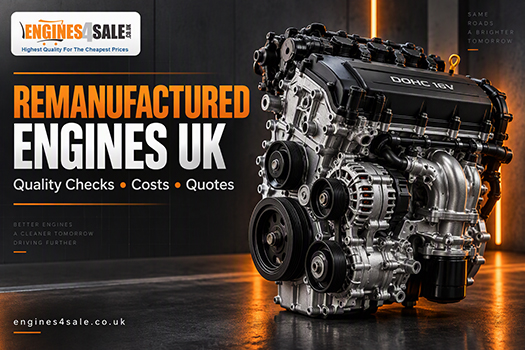
Remanufactured Engines UK: Costs, Quality Checks & Quotes
Buying a Remanufactured Engine in the UK? Comparing Quality, Warranty and Cost
Buying a remanufactured engine in the UK? Compare the rebuilding specification, test records, warranty and total fitted price—not just the advertised engine cost. This guide explains how to spot a poorly documented rebuild and request a quote you can compare with confidence.
How do you spot a quality remanufactured engine?
A quality remanufactured engine should come with a documented rebuild scope, component inspection and renewal records, relevant test results, traceable identification and written warranty terms. Ask the supplier to substantiate any claim of compliance with BS AU 257:2002, the British code of practice for remanufacturing spark- and compression-ignition engines. The label alone is not proof of quality.
- Rebuild standard: request written evidence supporting any BS AU 257:2002 compliance claim.
- Parts renewed: obtain an itemized list of replaced, machined and reused components.
- Testing: ask which checks were completed and request the recorded results.
- Quality marker 4: a unique serial number and full renewal record
- Engine warranty: confirm duration, mileage limits, labour cover and exclusions before payment.
These checks help you compare replacement engines for sale on evidence rather than appearance. No checklist guarantees a fault-free engine, but missing records make a quote harder to assess.
What is a remanufactured engine?
When comparing UK remanufactured engine suppliers, look beyond phrases such as “fully rebuilt” or “like new”. Ask what work was carried out, what specification was used and what evidence accompanies your particular unit.
A remanufactured engine is a used engine fully disassembled, cleaned, inspected and rebuilt back to the original equipment manufacturer’s specification. Every component is measured against factory tolerances and either machined back to spec or replaced.
BSI lists BS AU 257:2002 as the code of practice for remanufacturing spark- and compression-ignition engines. Ask for supporting documentation rather than treating a mention of the standard as independent certification. The following are useful rebuild details to request; they are not a substitute for checking the supplier’s stated scope.
- Complete disassembly, not a partial strip
- Every component inspected and measured against maker tolerances
- An itemized renewal record for pistons, ring sets, bearings, bushes, gaskets, seals and timing components, identifying what was replaced or retained
- Intensive cleaning, crack testing of machined parts and deburring of oilways
- Post-assembly checks of clearances, end floats, oil pressure and compression
Keep the agreed specification with your invoice. It gives you a clearer basis for comparing used engine replacement quotes and discussing any later concerns.
Remanufactured vs reconditioned vs rebuilt vs used engines
| Grade | Level of restoration | Industry standard | Typical reliability |
| Used | Checked donor unit | Check donor history and seller’s checks | Depends on donor |
| Reconditioned | Damaged parts replaced | Label alone does not establish a standard | Variable |
| Rebuilt | Worn parts replaced as found | Confirm the stated rebuild specification | Variable |
| Remanufactured | Full rebuild to OEM spec | Ask for evidence of BS AU 257:2002 claims | Depends on rebuild quality, installation and maintenance |
When comparing remanufactured vs reconditioned engines, remember that suppliers may use labels differently. Reconditioning and rebuilding can describe different levels of work; neither term tells you the full scope. Request a parts list, machining details and test records for every option. A standard manufacturing claim also needs supporting evidence.
Five checks before buying a remanufactured engine in the UK
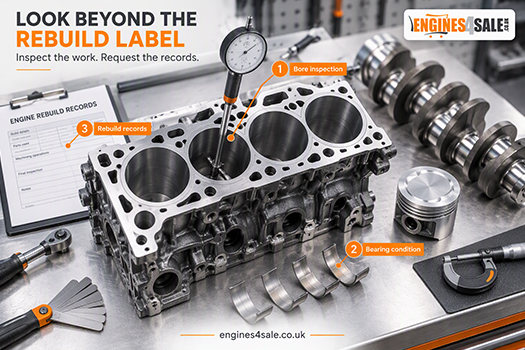
1. Verify the rebuilding standard. Ask the supplier to explain and document any BS AU 257:2002 compliance claim. If quality-management certification is advertised, confirm its scope rather than assuming it certifies your individual engine.
2. Compare the engine warranty. Ask whether cover includes parts and labour, how long it lasts and whether mileage is capped. A 12-month unlimited-mileage policy is useful to compare where offered, but it is not universal. Turbochargers and other ancillaries may have separate terms.
3. Check traceability. Request a unique serial number or other traceable unit reference, the completion date and a rebuild record linked to the supplied engine.
4. Request pre-dispatch test details. Ask which oil-pressure, compression, clearance and end-float checks apply to the supplied assembly. Obtain the results and acceptance criteria, not just the phrase “fully tested”.
5. Check the supplier and claim process. Review the business details, relevant experience and references. Confirm who handles delivery problems, fitting queries and warranty claims before choosing a replacement engine supplier.
How much does a remanufactured engine cost in the UK?
The cost of a reconditioned engine in the UK depends on the exact engine code and assembly specification. The original guide’s approximate ranges are retained below for illustration only; they are not verified current supplier prices or fitted quotations. Confirm availability, VAT, delivery, ancillaries and labour in a written quote.
| Engine type | Reconditioned (approx.) | Remanufactured (approx.) | New OEM (approx.) |
| Popular 4-cylinder diesel | £800–£1,500 | £1,500–£2,500 | £3,000–£5,000+ |
| Premium 6-cylinder diesel | £1,500–£2,500 | £2,500–£4,000 | £5,000–£8,000+ |
| Petrol 4-cylinder | £700–£1,200 | £1,200–£2,000 | £2,500–£4,500+ |
Compare the total engine replacement cost, not an assumed saving against a new OEM unit. Ask whether a refundable core deposit applies, what makes the old engine acceptable for return and when the refund is due. For engine supply and fit, have labour, fluids, filters and other agreed consumables itemised separately.
Need an engine replacement quote? Provide your registration, engine code if known and postcode, then specify supply-only or supply-and-fit. Request a written breakdown of price, availability, warranty and core-return terms so you can compare equivalent offers.
Bad engine rebuild warning signs: when to pause a purchase
- Units with no documentation — if you don’t know what was replaced, you don’t know what you’ve bought
- A remanufacturing-standard claim the seller cannot substantiate with supporting records
- Short or unclear warranty cover, especially where labour costs and the claim process are not explained
- Sellers who can’t explain what happens if the unit fails
Before engine replacement: diagnose the original failure
A replacement car engine can be damaged if the underlying fault remains unresolved. Have a qualified workshop investigate the original failure and check relevant cooling, fuel, turbo and EGR systems before fitting. Ask the supplier and installer to agree to any required remedial work and warranty conditions in writing.
After engine replacement: DVLA, MOT and insurance checks
- DVLA engine change: update the V5C where the engine number or cylinder capacity changes. GOV.UK lists acceptable evidence, including a replacement engine receipt showing the engine number and capacity.
- MOT after engine replacement: ask your tester to confirm the applicable emissions requirements using the current inspection manual. Vehicle first-use date and replacement-engine details matter; do not assume an engine swap creates an emissions exemption. Northern Ireland has separate testing guidance.
- Insurance: notify your insurer of the replacement and confirm any disclosure requirements and effect on cover under your policy.
What test records should a remanufactured engine include?
Ask how your remanufactured replacement engine was inspected and tested. The tests available before dispatch depend on whether you are buying a bare assembly or a more complete unit. Request recorded measurements where applicable and distinguish inspection work from running tests:
- Oil pressure verified to specification
- Compression measured across every cylinder
- Clearances, tolerances and end floats confirmed after assembly
- Crack testing of machined components
- Deburring of oilways to protect lubrication
The test sheet should identify the unit, checks performed and relevant results. If a test is not available, ask why and what alternative evidence supports the rebuild quality. A standard named in an advert does not replace unit-specific documentation.
Remanufactured engine warranty: what should you check?
When buying a remanufactured engine with warranty, compare the written policy rather than its headline duration. Check parts and labour cover, mileage limits, transferability, servicing requirements and exclusions for ancillaries or consequential costs. If 12 months’ unlimited mileage cover is offered, confirm exactly what it includes and who authorises a repair before work begins.
Are remanufactured engines a more resource-conscious option?
Remanufacturing reuses suitable engine components rather than replacing the entire assembly with new material. The original draft quoted roughly 85% component reuse and 55kg of core-metal savings per unit; those figures have not been verified for the engines offered here and should not be treated as universal. Ask for product-specific evidence before relying on a quantified environmental claim.
Which replacement engine option suits your needs?
| Situation | Option to consider—not a universal recommendation |
| Long-term ownership | Remanufactured |
| Restoration or rare engine | Remanufactured |
| Short-term, tight budget | Reconditioned (documented) |
| Only the price matters | Used, with donor evidence |
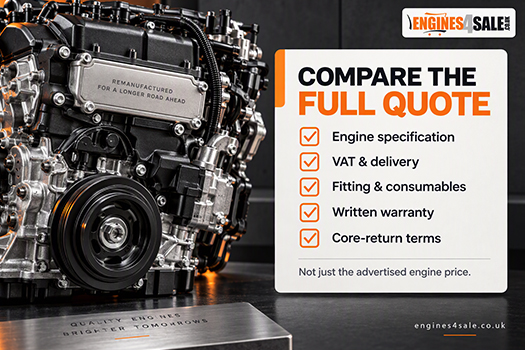
How to compare remanufactured engine quotes fairly
To compare engine quotes, give every supplier the same vehicle registration, engine code and fitting requirements. Confirm that each offer covers the same assembly and ask these five questions before comparing the final price.
What standard and specification? Ask for the agreed rebuild scope and evidence supporting any BS AU 257:2002 claim. “Full rebuild” without supporting detail is not enough to establish an equivalent offer.
What was renewed? Request a list identifying replaced, machined and reused parts, including relevant pistons, rings, bearings, gaskets, seals and timing components. “Everything needed” does not describe the work clearly enough.
What testing was done? Compare the available oil-pressure, compression, clearance and end-float records where applicable. Confirm that the documentation relates to the actual unit being supplied.
What does the warranty cover? Compare duration, mileage limits, parts, labour and exclusions. Ask whether the seller, remanufacturer or a third party handles a claim and whether fitting arrangements affect eligibility.
Who is responsible for the unit? Obtain a traceable engine reference, the selling business’s details and written responsibility for supply, fitting and warranty. Keep these with the invoice and rebuild record.
Finally, compare VAT, delivery, fitting, consumables and core-return conditions. A lower engine-only price is not necessarily a lower engine supply and fitting cost.
Is a remanufactured engine worth the extra cost?
A documented remanufactured engine replacement may offer better value than a cheaper, poorly specified unit, particularly if you plan to keep the vehicle. However, the purchase price alone cannot establish lifetime cost. Rebuild quality, installation, unresolved faults, maintenance and the warranty all affect the outcome.
Compare the total fitted bill with your expected ownership period and the vehicle’s condition. Do not assume any engine will avoid repeat repairs or automatically cost less over three or four years. The strongest offer is one with clear scope, evidence and responsibilities, not simply the lowest price.
Remanufactured engines UK: frequently asked questions
How can I check the remanufactured engine’s quality?
Request the rebuild specification, itemised renewal record, traceable unit identification, relevant test results and written warranty. Ask the supplier to substantiate any BS AU 257:2002 compliance claim. The word “remanufactured” alone does not verify the work.
Is a remanufactured engine the same as a reconditioned engine?
Not necessarily. Remanufacturing describes a comprehensive restoration to a defined specification, while reconditioning can involve a more limited scope. Supplier terminology varies, so compare the documented work rather than assuming the label guarantees a particular result.
What warranty should a remanufactured engine have?
Warranty terms vary. Compare duration, mileage limits, parts and labour, fitting requirements and exclusions. Where a 12-month unlimited-mileage warranty is offered, read the full terms rather than assuming it covers every component or associated cost.
Can I buy a supply-only engine or choose supply and fit?
A supply-only engine is supplied for installation by your chosen workshop. Engine supply and fit includes installation within the agreed scope. Confirm availability, including ancillaries, labour, consumables and warranty responsibilities before booking either option.
What information do I need for an accurate engine quote?
Provide your vehicle registration, engine code if available, postcode and whether you need supply-only or fitting. Ask the supplier to confirm compatibility and the assembly supplied, then itemise VAT, delivery, labour, consumables and any core deposit.
Is the cheapest replacement engine quote the best value?
Not necessarily. A cheaper quote may cover a different assembly or exclude fitting, VAT, ancillaries or delivery. Compare the rebuilding documentation, warranty responsibilities and total fitted cost on an equivalent basis before choosing.
Compare UK replacement engine quotes before you buy
Looking for remanufactured engines for sale? Compare remanufactured, reconditioned and used options against the same vehicle requirements. Request the engine specification, total price and written warranty from each supplier before deciding; price alone does not establish quality or suitability.Request an engine replacement quote → Have your registration, engine code if known, postcode and supply-only or supply-and-fit preference ready. Ask for availability, VAT, delivery, fitting, warranty and core-deposit terms in writing.


Categories
- Aston Martin
- Audi
- Auto News
- Auto Show
- Beijing auto show 2014
- Bentley
- BMW
- Bugatti
- Celebrity
- Chevrolet
- Citroen
- Classic Cars
- Cylinder Heads UK
- Dacia
- Engines
- Ferrari
- Ford
- General
- GM
- Google Car
- Guest Post
- Honda
- Hybrid Cars
- Hydrogen Fuel
- Hyundai
- Infographic
- Isuzu
- Iveco
- Jaguar
- Jeep
- KIA
- Lamborghini
- Land Rover
- Lexus
- Mazda
- McLaren
- Mercedes-Benz
- MINI
- Mitsubishi
- New Technology
- New York International Auto Show 2014
- Nissan
- Peugeot
- Porsche
- RAM
- Range Rover
- Recall
- Renault
- Rolls-Royce
- Saab
- Seat
- Skoda
- Smart
- Subaru
- Supercar
- Suzuki
- Toyota
- Uncategorized
- Vauxhall
- Volkswagen
- Volvo
- Wrong Fuel