Engine Problems, Fixes & Buying Tips
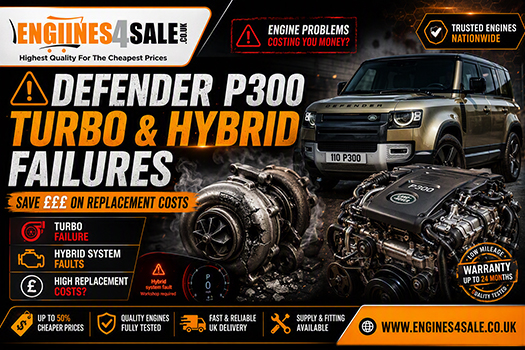
Land Rover Defender 110 P300 Engine Problems: Turbo Failure, Hybrid System Fault & Replacement Cost UK
Hybrid System Fault on Land Rover Defender 110 P300? Causes, Engine Solutions & UK Prices
Executive Summary
Modern downsized high-output luxury power units represent the outer edge of metallurgical and thermodynamic design. For professional precision engine machinists, independent JLR specialists, and fleet technical directors, handling a catastrophic component failure on a rebuilt Land Rover Defender 110 P300 engine requires looking past basic surface symptoms to address underlying alloy stresses and complex electrical integration.
The vehicle’s 2.0L four-cylinder Ingenium powertrain relies heavily on tight mechanical clearances and automated electronic actuators working in unison with a 48V electric assist network. When severe oil contamination or extreme thermal stress compromises this setup, it results in localized component warping, loss of structural cylinder compression, or complete turbocharger failure.
Sourcing a replacement block in the UK independent trade typically carries a total market used engine replacement cost UK range between £2,800 and £4,500 depending on the specific assembly type chosen. This manual outlines precise laboratory diagnostics, details the structural behavior of the Ingenium aluminum casting under extreme loads, and evaluates the engineering value of selecting a high-grade reconditioned engine versus a verified used engine core.
- The Machining Directive: Technicians must never authorize a replacement installation without performing a full pressure test and a microscopic structural crack check on the aluminum cylinder head. Thermal cycling from severe exhaust backup can warp structural sealing faces, leading to premature head gasket failure under high boost pressure.
- The Sourcing Guideline: When internal structural breakdown occurs, executing a precision-targeted engine sourcing strategy to find a premium remanufactured unit or a low-mileage used block is the most reliable way to restore factory performance.
Section 1: Metallurgical Vulnerabilities & Internal Friction Failures
Developing a robust solution for a failed drivetrain requires mechanics to analyze how specific engine alloys and high-pressure components behave under intense severe-duty operating conditions:
[Ingenium 2.0L I4 Petrol Core] [48V Mild-Hybrid Electric Array]
(Extreme thermal cycling creates rapid (Thermal energy and heavy chassis vibration
carbon deposits along the hot linkage) degrade internal circuit connections)
│ │
▼ ▼
[Electronic Wastegate Binding] [Sudden Drop in System Operating Voltage]
│ │
▼ ▼
[Catastrophic Turbocharger Failure] [Active Hybrid System Fault Warnings]
1. High-Temperature Wastegate Binding and Turbocharger Failure
- The Material Failure: The Land Rover Defender 110 P300 utilizes an advanced twin-scroll turbocharger controlled by an ultra-precise electronic actuator.
- The Impact: Extended service intervals and repeated short-trip delivery driving turn engine oil vapours into heavy, stubborn carbon deposits along the wastegate pivot arm. This structural contamination causes the wastegate mechanism to stick, triggering severe over-boost or under-boost conditions that eventually cause total turbocharger failure. Sourcing a top-tier reconditioned engine provides full peace of mind, as reputable remanufacturers completely renew the turbo assembly, replace failing actuators, and install updated internal oil seals.
2. BISG Heat Degradation and Hybrid System Fault Warnings
- The Material Failure: The integrated 48V Belt-Integrated Starter Generator (BISG) is mounted directly to the engine assembly, leaving it exposed to harsh engine bay heat and constant mechanical vibration.
- The Impact: This intense thermal exposure breaks down internal electronic modules, triggering a persistent Hybrid System Fault dashboard warning and forcing the vehicle into a protective limp mode. Statistics confirm that BISG malfunctions cause up to 28% of mild-hybrid-related breakdowns in premium UK SUVs.
3. Mechanical Cylinder Compression and Low-Mileage Used Sourcing
- The Material Profile: The Ingenium block features a lightweight aluminum casting integrated with high-tensile cylinder liners to withstand extreme operational combustion pressures.
- The Impact: If the block survives without suffering severe oil starvation or warped deck surfaces, the underlying metallurgy remains highly reliable. For owners managing strict budgets, purchasing a low-mileage used engine (under 40,000 miles) from an accident-damaged donor car offers a practical alternative, provided the 48V wiring loom and BISG housing are completely free of structural damage.
Section 2: Precision Workshop Tools & Installed Cost Factors
Successfully integrating an advanced mild-hybrid powertrain into an existing off-roader chassis requires specialized diagnostic equipment and a clear understanding of regional workshop rates:
- Advanced Tooling Protocols: Garages must execute specialized diagnostic protocols using JLR-compatible software, such as Pathfinder or SDD, to run complete module scans. These systems allow technicians to recalibrate the electronic turbo actuator linkage and reset the 48V battery module to prevent post-swap dashboard alerts.
- Managing Workshop Labour Costs: A complete mild-hybrid engine swap requires approximately 10 to 14 hours of highly meticulous laboratory labor. Sourcing your repair through a certified local independent specialist typically keeps labour costs manageable at £70 to £100 per hour, whereas main dealer franchises charge premium rates of £130 to £200 per hour, which quickly drives total bills to £7,000–£10,000. Ensure your workshop quote explicitly states if it includes the mandatory 20% UK VAT.
Section 3: Mandatory Engineering Checklist During Swaps
To protect your investment and ensure your independent components remain fully covered under your trade warranty, workshops must execute this strict mechanical framework during installation:
- Examine the 48V Battery Rail: Measure the operational voltage across the mild-hybrid battery circuit; any values dropping below 42V indicate a failing DC-DC converter or battery cell rather than a mechanical engine block fault.
- Inspect the Turbo Actuator Linkage: Thoroughly check the electronic wastegate linkage for any early signs of corrosion, mechanical binding, or carbon scaling before mounting the block into the vehicle bay.
- Cross-Reference Historic Records: Before installing a salvaged used core, use the official online GOV.UK MOT history checker to cross-reference and verify previous mileage trends across past inspection intervals.
- Get a Quote from Verified Networks: Avoid buying unverified parts from unrated private listings; always coordinate with reputable, fully vetted trade networks to compare component warranties side by side.
Frequently Asked Questions (FAQs)
1. How much does it cost to replace a Land Rover Defender 110 P300 engine in 2026?
While main dealers routinely quote £7,000 to £10,000, independent garage networks can source and fit a high-quality reconditioned engine for an overall engine replacement cost UK range of £2,800 to £4,000.
2. What triggers a sudden Reduced Engine Performance warning on the dashboard?
This alert typically indicates that the 48V Belt-Integrated Starter Generator (BISG) is malfunctioning or the electronic turbo actuator has failed to regulate internal boost pressure.
3. What special diagnostics should be performed before authorizing a full engine swap?
Technicians should run specialized hybrid system scans using JLR-compatible software (like Pathfinder) to check historical fault logs, verify actuator clearance, and test 48V system operating voltages.
4. Is it safe to buy a used engine core for the Land Rover Defender 110 P300?
Yes, choosing a low-mileage used engine under 40,000 miles from a non-structural accident donor is a highly practical solution, provided the 48V cabling and mild-hybrid electronics are verified uncompromised.
5. What are the typical workshop labour costs for an engine swap in the UK?
Independent specialists usually charge between £70 and £100 per hour, providing the best financial value, while manufacturer main dealers charge premium rates of £130 to £200 per hour.
6. Why do mild-hybrid system faults mimic structural turbocharger failure?
Because the 48V electric supercharger assist works directly in tandem with the turbo to eliminate lag, any electrical error in the BISG module can cause an immediate loss of power.
7. What mechanical issue causes the P300 turbocharger wastegate to stick?
Over time, intense heat cycles turn oil vapours and fuel residues into severe carbon deposits along the wastegate linkage, causing the mechanism to stick and trigger turbocharger failure.
8. Does utilizing an independent garage network void my vehicle’s manufacturer warranty?
According to the UK’s Competition and Markets Authority (CMA), using an independent trade specialist does not void your warranty, provided the replacement parts meet strict OEM specifications.
9. How long does a complete engine block swap take to execute?
Due to the complexity of the mild-hybrid wiring, electronic calibration, and plumbing, a complete replacement typically takes 2 to 4 business days in a professional garage.
10. Where is the safest place to obtain verified powertrain quotes in the UK?
Vehicle owners should consult trusted nationwide trade platforms to get a quote from fully vetted UK suppliers specializing in JLR mild-hybrid units.


Categories
- Aston Martin
- Audi
- Auto News
- Auto Show
- Beijing auto show 2014
- Bentley
- BMW
- Bugatti
- Celebrity
- Chevrolet
- Citroen
- Classic Cars
- Dacia
- Engines
- Ferrari
- Ford
- General
- GM
- Google Car
- Guest Post
- Honda
- Hybrid Cars
- Hydrogen Fuel
- Hyundai
- Infographic
- Isuzu
- Iveco
- Jaguar
- Jeep
- KIA
- Lamborghini
- Land Rover
- Lexus
- Mazda
- McLaren
- Mercedes-Benz
- MINI
- Mitsubishi
- New Technology
- New York International Auto Show 2014
- Nissan
- Peugeot
- Porsche
- RAM
- Range Rover
- Recall
- Renault
- Rolls-Royce
- Saab
- Seat
- Skoda
- Smart
- Subaru
- Supercar
- Suzuki
- Toyota
- Uncategorized
- Vauxhall
- Volkswagen
- Volvo
- Wrong Fuel