Engine Problems, Fixes & Buying Tips
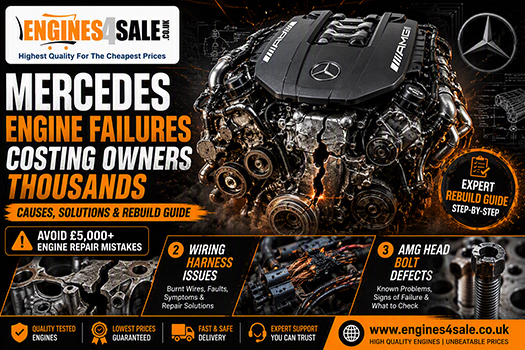
Mercedes Engine Problems Explained: Material Failures, Wiring Harness Issues, AMG Head Bolt Defects and Rebuild Guide
Mercedes Engine Replacement Costs and Buying Advice in the UK
Executive Summary
Modern premium automotive engines are highly advanced systems built out of complex metal alloys designed to reduce weight, maximize structural strength, and handle extreme combustion pressures. However, housing high-output configurations within tight engine compartments subjects’ internal parts to intense thermal stress.
When a critical cooling part or timing tensioner fails, the resulting intense heat causes different metal components to expand at different rates, leading to severe structural warping, broken cylinder head gaskets, and electrical degradation. For precision machinists, automotive engineers, and independent engine rebuilders, fixing a damaged premium engine requires a deep understanding of metallurgy, strict mechanical tolerances, and advanced troubleshooting steps.
This technical bench manual provides a highly detailed engineering breakdown of material vulnerabilities across various engine configurations, maps out precise machining steps, outlines fluid engineering specs, and evaluates the financial realities of rebuilding versus replacing a damaged block assembly.
- The Machining Directive: Never attempt to resurface a warped cylinder head or engine block without first conducting a comprehensive micro-crack and pressure test. Thermal fatigue can create hidden fractures within the metal casting that will cause premature engine failure under load.
- Component Strategy: When a cylinder casting develops structural cracks or severe distortion, swapping the block with a fully verified used engine or a factory-standard reconditioned engine is the safest way to ensure long-term reliability.
Section 1: Metallurgical Failures & Electrical Degradation
Independent machine shops must look closely at how specific engine models react to thermal stress and material aging over time:
[Late M104 / Early M119 Blocks] [M156 AMG Performance Units]
(Biodegradable insulation breaks (Original cylinder head bolts
down from heat, causing shorts) stretch and snap under high loads)
│ │
▼ ▼
[Catastrophic Electrical Failure] [Blown Gaskets / Liquid Mixing]
1. The Biodegradable Wiring Harness Issue (Late M104 & Early M119)
- The Failure: Despite having exceptionally strong iron and aluminum cores, late-production M104 Inline Six and early M119 V8 engines were fitted with eco-friendly, biodegradable electrical wiring harnesses.
- The Impact: Over years of exposure to normal engine heat, the insulation on these wires’ cracks and crumbles away. This exposes the bare copper wires, leading to unpredictable short circuits, ECU damage, and engine misfires. When sourcing these classic blocks as a rebuilt Mercedes engine, checking for an upgraded, non-biodegradable wiring harness is mandatory.
2. Tensile Head Bolt Failures (M156 AMG Pre-Update)
- The Failure: Early versions of the high-performance M156 AMG (pre-update) V8 engine suffered from weak factory cylinder head bolts. Under high combustion pressures, these bolts can stretch and snap.
- The Impact: This allows coolant to leak into the combustion chambers and mix with the engine oil, risking complete engine failure. Rebuilders must ensure that updated, high-tensile head bolts are installed during the reconditioning process before using these blocks in performance SLS AMG engines, C-Class AMG, or E-Class AMG models.
3. Supercharger Friction Wear (M111 Supercharged)
- The Failure: The supercharged four-cylinder M111 Supercharged engine uses an electromagnetic clutch pulley to drive its supercharger.
- The Impact: Over time, the internal clutch plates and bearings wear down, causing a severe drop in boost pressure and creating a loud metal grinding noise under acceleration.
Section 2: High-Durability Alloys — The Engineering Successes
While certain engines require careful inspection, other configurations feature excellent material selection and robust designs:
- The Aluminum-Silicon V8 (M113 V8): Regarded as one of the most reliable multi-cylinder engines ever designed, the M113 V8 features a highly durable, simple design that provides incredible longevity across CLS, S-Class, SL, and certain G-Class engines.
- The Robust Six-Cylinder (M112 V6): Widely utilized in older C-Class, E-Class, CLK, and SLK engines, this unit features smooth operation and exceptionally low running costs due to its durable construction and low-wear internal design.
- The TwinPower Specialist (M178 AMG 4.0 Biturbo): Serving as the core powerplant for the high-performance Mercedes-Benz AMG GT engines, this block utilizes advanced structural casting techniques to combine intense performance with outstanding mechanical reliability.
Section 3: The Mechanical Commissioning Framework
When preparing to install a replacement power unit or perform a complete rebuild, independent workshops must follow this precise engineering checklist:
- Flush and Clean the Cooling System: Overheating dramatically shortens engine life. Always pressure test the radiator and clean out all debris before bolting in a replacement engine.
- Calibrate Fluid Viscosity: Always use approved Mercedes-Benz engine oil UK (typically 5W-30 or 5W-40 depending on exact factory guidelines) to ensure adequate oil film thickness across the main crankshaft bearings.
- Get a Quote: To avoid unexpected workshop costs, always seek accurate details from an authorized engine distributor to compare the costs of a bare used component against a fully assembled reconditioned engine complete with fresh gaskets and updated timing gear.
Frequently Asked Questions (FAQs)
1. What is the most reliable engine ever made for this brand?
The M113 V8 is widely regarded as the most reliable engine, known for exceptional longevity, simple design, and minimal failures across the CLS, S-Class, SL, and certain G-Class engines.
2. Which engines should be avoided when buying used?
Avoid early M272 and M273 engines due to balance shaft and timing issues, and early OM651 and OM642 diesels due to injector and swirl flap problems.
3. Are the diesel engines reliable for long journeys in the UK?
Yes, engines like the OM617, OM606, and OM648 are known for exceptional durability and handle long-distance motorway driving conditions exceptionally well.
4. What engine lasts the longest under proper care?
The OM617 diesel is famous for reaching over 500,000 miles, and many survive over a million miles with proper maintenance.
5. Which layout is best for motorway driving?
The OM648 diesel and M256 inline-six are both excellent for long-distance cruising thanks to strong torque and fuel efficiency.
6. Are reconditioned power units worth buying?
A high-quality reconditioned engine from a trusted supplier is a smart choice and can be more reliable than a high-mileage used engine.
7. What oil should be used in the UK?
Use approved Mercedes-Benz engine oil UK, typically 5W-30 or 5W-40, depending on the engine and climate. Always follow the handbook.
8. Do the timing chains last the lifetime of the vehicle?
Some engines have lifetime chains, but others like early M274, M276, and M271 require earlier inspection or replacement.
9. Which engine is best for heavy towing?
The OM642 diesel and M256 inline-six are excellent towing engines with plenty of torque.
10. Where can I get a replacement engine in the UK?
You can request specialized options from trade suppliers who offer used engines, reconditioned engines, and low-mileage imports for all vehicle models.


Categories
- Aston Martin
- Audi
- Auto News
- Auto Show
- Beijing auto show 2014
- Bentley
- BMW
- Bugatti
- Celebrity
- Chevrolet
- Citroen
- Classic Cars
- Dacia
- Engines
- Ferrari
- Ford
- General
- GM
- Google Car
- Guest Post
- Honda
- Hybrid Cars
- Hydrogen Fuel
- Hyundai
- Infographic
- Isuzu
- Iveco
- Jaguar
- Jeep
- KIA
- Lamborghini
- Land Rover
- Lexus
- Mazda
- McLaren
- Mercedes-Benz
- MINI
- Mitsubishi
- New Technology
- New York International Auto Show 2014
- Nissan
- Peugeot
- Porsche
- RAM
- Range Rover
- Recall
- Renault
- Rolls-Royce
- Saab
- Seat
- Skoda
- Smart
- Subaru
- Supercar
- Suzuki
- Toyota
- Uncategorized
- Vauxhall
- Volkswagen
- Volvo
- Wrong Fuel